zaterdag 16 juni 2012

The weeds in my street [2012] [38 plants]

"Know the flowers" - Gary Snyder

'Weed' - a plant that is self-propagating and 'wild', not a plant that is necessarily unwanted or harmful.  

'My street' - The street where I live in Whiteladies, Utrecht, The Netherlands.

My botanical skills remain poor but I would love to become one of these forage dandies who without blinking an eye can smugly recognize a plant from a single leaf from 100 meters away as if it is the commonest thing in the world. Mind you, when there of two of those types together arguments over correct identification are bound to follow and the certainties of one individual turn out to be another person's bluff. Since the previous edition of weeds-in-my-street in 2011 I have learned a few new names and the confusion of plants is slowly becoming less of a confusion. Hopefully this will help in seeing all plants. The Weeds in my Street is a working document (last update mid June) and I will add pictures as the year progresses.

As far as I can remember there never used to be that many wild plants in the city. But somewhere along the line, only a few years ago, local authorities decided to stay away from weed killers and manage weeds with ecological means. In Utrecht the city council introduced these four-wheeled street blow-dryers to burn the crap out of wild plants. This form of weeding, I see these cars maybe 3 or 4 times a year, is beneficial to plant diversity. It creates an environment that is welcome to many different plants, provided they are fast growing and not to picky. It will also lock out some other plants that need more time to reproduce (the biannual yellow primrose say?). By weeding with heat no plant gets a chance to dominate and diversity is the result. It's only my theory (based on work on biodiversity covered earlier) and I would love to hear what an expert would say.

The ultimate aim of this project? To be able to name all weedy plants in my street, to know where they originate from, to know a little about edibility, pharmaceutical properties and the lore associated with them. In the end I want to give a number to plant diversity in my own backyard, I want to get a sense of plant communities in street conditions in comparison to other local but different environments. 

For some plants I have added notes from 'Sturtevant's edible plants of the world' but this turned out to be a tedious task without real benefit.

Several readers have helped me identify plants here and their help has been much appreciated!
 
These red valerians were identified with your help (earlier) and they are now preparing for summer on top of the unweeded ones of last year. Sturtevant tells us that "Red Valerian is said to be eaten as a salad in southern Italy."

The hollyhock is the empire weed of summer around here and I can't stand them, I do find it endearing that their leaves are concave and can collect rain or, in this case, dust. Sturtevant: "This species grows wild in China and in the south of Europe. Forskal says it is cultivated at Cairo for the sake of its leaves, which are esculent and are used in Egyptian cookery. It possesses similar properties to the marshmallow and is used for similar purposes in Greece."

This plant has been fascinating me for a while; the shape of its leaves, its symmetry, even its pleasant colour have made me take a fancy to it. Only when I finally learned about its yellow four-petal flower did I learn its name: greater celandine and its not just any other plant. It is part of the family of the poppy and a greater celandine poisoning should be treated as a morphine overdose. So it's a storehouse of chemicals and widely used in herbalogy and pharmacy. In my street this plant is not yet flowering but a few blocks from here it is; is that what they mean with urban micro-climates? Sturtevant: "The leaves were eaten as a food in China in the fourteenth century." It's part of the Papaveraceae or poppy family and native to Eurasia.

Last year I asked about this plant and it was suggested by several people that it is a creeping buttercup, however, I have now learned, the cr. buttercup has bright yellow flowers while this common weedy plant has white flowers. Readers Felix and Bobby independently suggested wild geranium and indeed we are dealing here with a plant that is native to North America and escaped from ornamental gardens. Its qualities as a carpet-growing ultra-competitive plant are without doubt: they can make the most of sunlight from whatever angle it is coming.

The red dead nettle can be found in all my wild food guides and it certainly is a pleasant plant to behold. Sturtevants disappoints: "Europe, northern Asia and naturalized as a weed in some places in the United States. The red dead-nettle, or archangel, is eaten in Sweden as greens in spring."   

The dandelion! It is so common that you tend to forget about them but they are the true superweeds, the plant on which the sun never sets as Alfred Crosby had it. And when looking at a Dutch dandelion, where it is perfectly in place I try to think about all those places where it was not in place originally and is now and my mind boggles. I was on my bike the other day and I saw them growing in the fields along the busiest road here and they were perfectly inconspicuous, growing here and there, pleasant not weedy. It's edibility is well known and Sturtevant's entry is long and extremely dated, a fragment:
The dandelion is highly spoken of as a spring green by various authors and has been used as a food plant in many regions but it has only recently come under cultivation. When a swarm of locusts destroyed vegetation in the Island of Minorca, the inhabitants subsisted on this plant, and, in Gottingen, the dried root has been used as a substitute for coffee. In 1749, Kalm speaks of the French in New York preparing and eating the roots as a common salad but not usually employing the leaves. The plant is now eaten raw or cooked by the Digger Indians of Colorado and the Apaches of Arizona. In 1828, Fessenden says the wild plant is used by our people but is never cultivated. In 1853, Mclntosh, an English author, had never heard of dandelions being cultivated. They are now extensively cultivated in France, and, in 1879, five varieties appeared in the French catalogs.
Street conditions aren't optimal for the stinging nettle but this specimen growing between the paving and the curb gives a fine example of its acumen for survival. It's cultural legacy is large and varied. Sturtevant's entry on the nettle is a muddle: "Naturalized in America from Europe. The nettle, according to Sir Walter Scott, was at one time cultivated in Scotland as a potherb. Nettle tops, in the spring, says Lightfoot, are often boiled and eaten by the common people of Scotland as greens, and the young leaves are often boiled in soup in the outer Hebrides and form a very palatable article of food, it is said. The tender tops are much more commonly eaten in Germany, Belgium and other parts of Europe than in England and are also used in northern Persia. "

The common groundsel  is a loner. There is only one of them in my street and I have seen them only sporadically in the neighbourhood. This is again a persistent plant that grows everywhere and doesn't care about frost. It has a long herbal history, it was used as defence against witches and placed in cribs to protect babies from evil. At least it is well-willing.


The hairy bittercress (but am waiting to see the flowers to be 100% sure) is part of the mustard family and a well loved urban foraging green. The first picture is a spectacular case of making the most of a rotten situation, the second shows it in better form. Sturtevant: "Ross calls this the scurvy grass of Tierra del Fuego; it is edible. Lightfoot says the young leaves, in Scotland, make a good salad, and Johns says the leaves and flowers form an agreeable salad. In the United States, Elliott and Dewey both say the common bitter cress is used as a salad."
Reader Ed in the comments believes that is something else and he could be right, who helps us out.
The picture is a bit dodgy but here is the common chickweed. In a few weeks it will show its flowers:lovely shaped white petals. It thrives on disturbances and has a long history of use. Sturtevant: "This plant is found in every garden as a weed. It forms when boiled, says Johnson, an excellent green vegetable, much resembling spinach in flavor and is very wholesome." 


Thale cress is one of many fragile-looking white-flowering plants that are not fragile at all.

Shepard's purse is another fragile white-flowering plant, but one with many uses and a more pronounced cultural history.

The prickly poppy, from Africa and Eurasia.I can't remember it from last year but it needs very little space and is very dominant in some places.
The creeping woodsorrel (between a prickly poppy and a dandelion) has a tangy lemony taste but if you eat to much of it can inhibit calcium intake, or so Wikipedia tells us. 

The plantain/plantago comes in 200 species, we have seen it as the Englishman's foot and I am glad it's in my street too.

The only ground elder in Whiteladies that I know about, but it grows in shadowy places and this might well be the shadiest place in my street. I am told it is great in pesto. It's just so weedy. 
 
Never before did I hear of the yellow corydalis but like the greater celandine above it's part of the papaver family. It originates from the alps and it's a plant that easily escapes from gardens. The drooping flowers I find slightly distasteful.

 This is perhaps the strangest find: I associate white clover (also Dutch clover) with grass not with pavement, and I have yet to find it elsewhere here. It's a plant of the old world that is now common elsewhere.

With my zombie camera skill the Wall lettuce proved unable to capture with anything near the finesse of a garden magazine but this is a fine plant with bright five petals flowers that are actually 5 different rayflowers. It's part of the Composite family (actually: Aster) and native to Europe.

With help from reader Claude I learned that this plant is the alkanet (the dutch name is fascinating). It's an escaped garden plant native to south-western Europe in the family forget-me-not. 

I tasted this plant and I thought it was some sort of rucola, but it's a bog yellowcress, part of the mustard family native to Europe, Asia, North Africa, and North America. Nice plant, not terrible abundant but growing here and there with a mild persistence.
You just know that this must be an escaped garden plant, it's the Servian Bellflower, as the name says it originates from the Dinaric Alps in the Balkan and it's in the bellflower family. This one grows between the Red Valerian above, which makes for a good colour combination. 

This one I can see when I am in front of my front door, it's between the the curb and paving on a parking spot. This is a kind of Galinsoga, the flowers are very distinct. It's in the Aster family and first arrived in Europe from South America in the late 18th century. It looks a vaguely like nightshade and one of it's nicknames is potato weed. There is a whole range of herbal uses for this plant. 

The common sowthistle belongs to the Aster, the English Wikipedia deals entirely for its edible and medicinal properties. It's native to Eurasia.


The hedge mustard is a common plant here and it is of the mustard family . It has unobtrusive little yellow flowers and the stalks look coiled. Wikipedia tells us that at places it is cultivated. It's native to Europe and North Africa.

In Dutch this plant is the 'American Herbcress' but it is better known as Virginia pepperweed or peppergras. The young seedpods can be used as a substiture for black pepper, hence the name. It's an introduced specie from America that arrived here in silence, packed with grain and grass seeds. It does well in cities only. It's in the Mustard family.

Unmistakably pigweed or common knotgrass. A plants that likes to be walked on and is so in abundance. It's in the knotweed family and common throughout the world.

Canadian horse weed is a common throughout the country and in my street. The plants was first reported in France in 1665 and spread from there throughout Europe. It is amazing to see how fast these things grow, elsewhere they have started to bloom but due to shade my street always lags behind. It's in the Aster Family.    

If I am not mistaken ferns are usually a sign of undisturbed ground and, so far as I can tell, this tiny male fern is the only specimen of its kind in my street. 

 Another fern, the wall rue, it likes wet cement.

This one grows behind a metal fence, the size of the flowers make me suspect this is an escaped ornamental plant rather than a traditional wild plant; two readers suggested the Nettled leaved bell flower. It's primarily a wood plant. 

 A tiny redshank, it's a common species, according to Dutch Wikipedia the seed is collected by bird-lovers. Of the knotweed family, native to Eurasia.

Tansy grows everywhere but in my street it has found a home in only one ornamental flowerbed. Glad it's here. It's of the Aster family and native to Eurasia.

With it's strong stem and thorny leafs this plant stands out, the day after the picture was taken its identity revealed itself: a tiny bit of yellow flower had popped out and the thistles seemed a bit more thistly. It is a sowthistle but not an ordinary one like above but a swine thistle. 

There are 2 black nightshades in my street, both in the same flowerbed. One looks poorly and the other is doing OK. My street would improve with a bit of black magic and this is a great find. It's native to Eurasia.

This is the purple top. It's growing here in a untended flowerbed but the plant itself can be seen all over in those parts of the neighbourhood where people have flowers. So is it wild? It may be,they are wild nearby. The picture on the wikipedia page looks the same as this one, the picture on the Dutch wikipedia (ijzerhard) makes me think that the above plant is a cultivated South-American variant. I am including it here, but will not count it.      

This plant is growing at selected street sides in the neighbourhood and they were taller than this paltry specimen. Readers suggested common chirocy an there is a resemblance but I am not sure. Are you?  


Found in a flowerpot next to someone's front door: a daisy hiding itself between a bunch of bell flowering cultivated freaks. I have started taking notice of what family plants belong to and such a common plants has to be a composite. 

A plant with an archetypical flower (as children draw them). A reader identified it as a Bacopa, or to be more precise the Sutera.  A garden website points us to the 'Sutera cordata Snowflake'. So this is yet another escaped garden plant. 

A diminutive plant that can be found at three or four places in my street. Two reader helped identify it as a Epilobium or Willowherb which a is gigantic family. It probably is a square stemmed willowherb but put that between brackets for now.

+++++ One plants lacking a name, can you help?? ++++


 Sole representative of an unknown species. An escaped garden plant? Do you know it?

vrijdag 15 juni 2012

My Name is Hou Je Bek and I'm a Psychogeographer [edited]


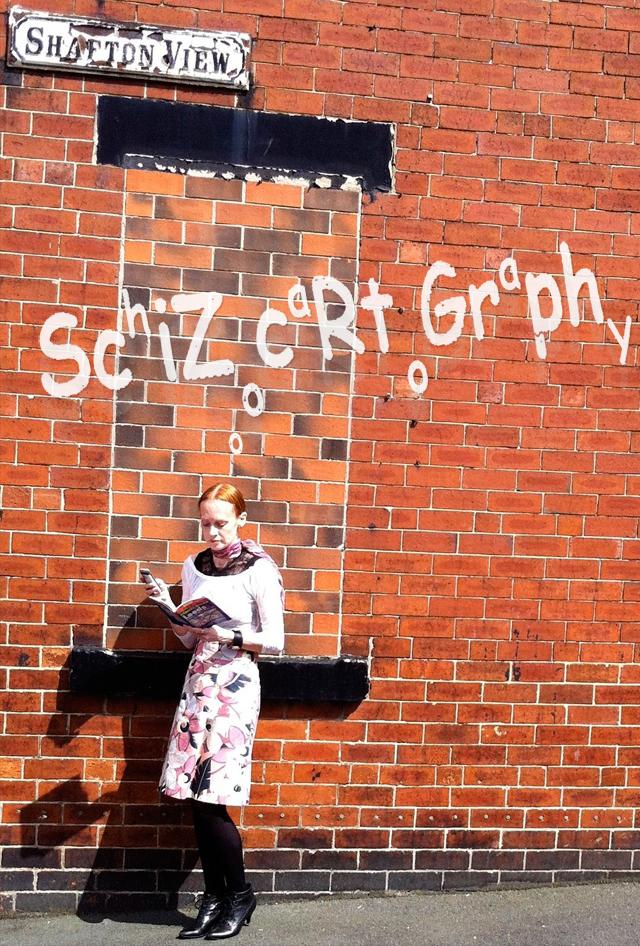
Just in today is Tina Richardson's paper "My Name is Tina and I'm a Psychogeographer: Situating the Addictions and Abuses of Urban Walking Today". From my perspective it is a very funny review of the experienced pitfalls of current psychogeographicness. It tries to come to grips with such eternal questions as: who is 'psychogeography' and who is a mere pedestrian and who is entitled to make such a decision. It covers the 'domination' of Iain Sinclair over the field as if he is the Jamie Beswick of the funny walk, the uncertain status of Will Self as psychogeographer, the tactic (or is it a strategy) to coin terms like Deep Topology or Schizocartography to set oneself apart, and in general how something that is as vaguely defined as psychogeography can be prevented from abuse by snobs and careerist fucks who use the word without ever having pained themselves with the anti-modernist sandpaper redemption of situationist-Marxism. 
I recently asked my thesis supervisor what she thought about the increased popularity of psychogeography, as I am somewhat ambivalent about it myself. She thought it was a good thing, but I think she meant this in regards to my future career, because she believes I have caught the wave intime. My own ambivalence is hinged around a practise that I consider to be - by degree - subversive,underground, anarchic and operating against the grain.
In my experience psychogeography is continuously rediscovered, going through its own booms and busts. For many (students of art, urban planning and assorted disciplines) it's  a phase, a allegiance they grow out of after a while.

Another thing to be said is that there exists a huge field of of art that works with walking/exploration/mapping and often these people are paying lip-service to psychogeography without labelling themselves as such. Calling yourself a psychogeographer means placing yourself in a very specific tradition and not everybody, for various reasons, feels comfortable doing that. For others this cultish aspect of psychogeography is part of the appeal. In this light I find it remarkable that Will Self, as an established writer and media-celebrity whose books do terribly well, volunteers himself as a disciple (to use a big word) of a tradition that is bigger than all of us.

What did William Burroughs say about art: It's a three letter word. Psychogeography is a fifteen letter word, it's not a profession or a career or an occupation, it's an attitude like vegetarianism or protestantism which is important to people but not by necessity a reason for people (like vegetarians) to get along or agree on even the most basic facts of life.    

woensdag 13 juni 2012

The North Pole #Brainfuck [Ps-y.co[ph]ysi,x Night.Walk]


THE NORTH = A POINT EXPRESSING AN IDEA WHOSE TIME HAS PASSED

"The navigator knows the geography, he watches the stars at night, watches the sun at day; when it is dark and cloudy, he watches the compass." - Zhu Yu (1119)

"Right under the Pole there lies a bare rock in the midst of the Sea. Its circumference is almost 33 French miles, and it is all of magnetic stone. And is as high as the clouds, so the Priest said" - Mercator (1577, IMAGE E)

"As the magnetic needle which points to the north necessarily indicates thereby the south, so the power disposing to rest has necessarily a counteracting influence disposing to mobility, between which lies the point of indifference" - Samuel Taylor Coleridge (1848)

"I suppose this desire to reach the North Pole is only a piece of vanity" - Fridtjof Nansen (1897, IMAGE F; first polar magnetic observations)

"The two poles wander independently of each other and are not directly opposite each other on the globe. They can migrate rapidly: movements of up to 40 km per year have been observed for the North Magnetic Pole" - Wikipedia (2012)

THE NORTH = THE NAVIGATIONAL TAR PIT 

It is really hard to know what the earth is doing, but we do know that it must be doing something.

The Real North wobbles [IMAGE C], the Magnetic North drifts [IMAGE B], the North Star shifts in and out of focus [IMAGE D]. Eventually all places will be a North Pole of some description for some time.

Psychogeophysics is the art of knowing a place for a million years and finding ways to compress that knowledge into a shareable experience.
 
THE MAGNETIC NORTH = THE POINT AT THE END OF EVERY COMPASS = A MILLION WALKS

The North Pole is like the moon, a symbolic place to wave flags and risk your life [IMAGE G].

 
The North is a point everywhere but here: let's move a little closer [IMAGE H] with a compass in hand, Polaris in sight, following declinating path[s] as we assume all former states of Northern Poleness to exist simultaneously, as forking paths confused and amalgamated, our directions calculated by threated #brainfuck loops. A .walk that wobbles and drifts with the earth itself.

THE NORTH = THE POINT THAT EXPLICATES THE POINTLESSNESS OF ALL POINTS FOREVER FIXED

IMAGE B
IMAGE C
IMAGE D
IMAGE E
IMAGE F

 IMAGE G
 IMAGE H

maandag 11 juni 2012

'Molongo' is the new buzz word


In a paper called "Long-Term Foraging Expeditions (Molongo) among the Baka Hunter-Gatherers in the Northwestern Congo Basin, with Special Reference to the 'Wild Yam Question'" Hirokazu Yasuoka "describe[s] and analyze[s] a long-term foraging expedition (molongo) among the Baka of the northwestern Congo Basin as an example Long-Term Foraging Expeditions of foraging life in tropical rainforests. On the basis of these data, I then discuss the potential of tropical rainforests as a human habitat." 

There is lot of energy intake calculating going on in this paper but for our purpose it is enough to give you a few of the images and that part of the text that explain the daily proceedings of the Baka life during the vacations expedition. What amazes me is how slow the trek proceeds. The final camp is roughly 50 kilometres away but it takes 16 days to get there while it only takes 6 days to get back. On the molongo people take it slow. 
An important sociocultural aspect of molongo is the value placed on a nomadic life in the forest. When on the move, the group would usually decamp at about eight o’clock in the morning, often breaking into several sections to variously hunt such animals as they encountered or gather plants and honey. In the early afternoon when they decided on the location of the new camp, the women began to build huts of saplings and large Marantaceae leaves, while the men again went hunting with spears or to look for honey. When fresh tracks of a large animal were found, the hunter and his assistants perused it with the gun. The Baka moved the campsite every few days before arriving at the final camp of Mongungu, where they continued to use the forest intensively for their 43 night stay. 

Once at the Mongungu camp the men set cable snares along seven routes of 2–4 km stretching in a radial pattern from the camp. Hunters visited their snares every three days, because trapped animals spoiled within two days of dying. Men searched for honey or hunted with spears on the other days. The women went out digging for wild yams every two or three days, sometimes accompanied by their husbands. The wild yam species harvested most frequently was Dioscorea praehensilis, which can be found in large quantities in one place. Almost all of the cable snares and the major gathering sites for wild yams were within 3 km of the camp, so the most intensively used area was approximately ∼30km2.
The article is behind the academic firewall, with many tanks to a reader for the PDF.

zaterdag 9 juni 2012

Tuniit art in the medieval warm period


Robert McGhee's 'The last imaginary place' surveys the human history of the Arctic north, showing that people without history (to use the phrase by Eric Wolf, another brilliant book I am reading at the moment ) do have a complex, living past. The history of the now extinct Tuniit or Dorset culture is worth your attention, I was particularly intrigued by the following quote that links the number of artistic artefacts with the despair brought about by climatic change:
 The art of the Dorset people is so varied and intricate that it allows a glimpse of the spirit-world known to these ancient hunters, a world resembling in many ways that of the other northern shamanic peoples, yet unique to this society that developed in the relative isolation of Arctic North America over a period of almost five millennia. Their art also appears to foreshadow the end of Tuniit society. In the last few centuries of their existence, between about AD 1000 and 1500, Dorset artists produced an ever-increasing number of amulets and objects of shamanic use. This was also the period of increasing stress on the societies to which the artists belonged. In these centuries the Northern hemisphere was subject to warming climatic conditions that are known in Europe as the Medieval Warm Period. To Tuniit hunters who seem to have been adapted to primarily to hunting on land and sea-ice, the unexpected appearance of open water during early summer or a delay in the expected freezing of autumn seas would have brought hardship and often disaster.
At the same time the Viking were using the warmer conditions to find their way to Greenland and beyond.  Image:"Miniature ivory mask representing a humanface, Dorset, Devon Island, Nunavut, circa 1700 B.C." Possibly it's a portrait, they lines may represent tattooing? A humbling face.

woensdag 30 mei 2012

A little bit of Gerrard by my side, a little bit of Winstanley is all I need, a little bit of revolution in the sun, a bit of proto-communism all night long

The special quality of the writing of Gerrard Winstanley (1609-76), the radical English protestant priest often seen as a proto-communist-communard, is that it's easily incorporated by radicals who came after him. To give a recent example, the San Francisco Diggers named themselves after Winstanley's followers and provided free food after their example. In the light of Transition, Dark Mountain, Occupy and bioregionalism Winstanley is again quotable as a forerunner of all back-to-the-land gardeners and farmers. Question: does foraging 'make the earth fruitful?' 
...one sort of children shall not be trained up only to book learning and no other employment, called scholars, as they are in the government of monarchy; for then through idleness and exercised wit therein they spend their time to find out policies to advance themselves to be lords and masters above their labouring brethren, as Simeon and Levi do, which occasions all the trouble in the world. 
The first fountain is the right planting of the earth to make it fruitful, and this is called husbandry. And there are two branches of it: As first, planting, digging, dunging, liming, burning, grubbing and right ordering of land, to make it fit to receive seed, that it may bring forth a plentiful crop. And under this head all millers, maltsters, bakers, harness-makers for ploughs and carts, rope-makers, spinners and weavers of linen and such like, are all but good husbandry.

The second branch of husbandry is gardening, how to plant, graft and set all sort of fruit trees, and how to order the ground for flowers, herbs and roots for pleasure, food or medicinal. And here all physicians, chirurgeons, distillers of all sorts of waters, gatherers of drugs, makers of wines and oil, and preservers of fruits and such like, may learn by observation what is good for all bodies, both man and beasts.

....an idle, lazy contemplation the scholars would call knowledge; but it is no knowledge but a show of knowledge, like a parrot who speaks words but he knows not what he saith. This same show of knowledge rests in reading or contemplating or hearing others speak, and speaks so too, but will not set his hand to work. And from this traditional knowledge and learning rise up both clergy and lawyer, who by their cunning insinuations live merely upon the labour of other men, and teach laws which they themselves will not do, and lays burdens upon others which they themselves will not touch with the least of their fingers. And from hence arises all oppressions, wars and troubles in the world; the one is the son of contention, the other the son of darkness, but both the supporters of bondage, which the creation groans under.

dinsdag 29 mei 2012

Reviewing TheState, Volume 1


The State is a website and magazine based in Dubai. The State's first volume 'voicings/articulations/utterances' appeared about a month ago, it's in A4, black and white with a few pages in full colour, to be read not from left to right but from top to bottom with the binding held horizontal. The writing is of a consistent good quality and all writers aspire to write about what is happening in the world now in a language that is journalistic-academic, serious but without jargon. My favourite pieces are the personal reflections on identity, politics and the prospects of life to come. There is one awful piece which is by myself and deals with some of the finer points of cryptoforestry in a globalized world. From my perspective the best thing about The State is that it offers a collection of voices I would never have come in touch with otherwise: the main connection seems to be between India, the Gulf states and the United States, with people coming from one of those places and living in one of the others. I think that the overall mood of The State is one of insecurity. Most writers are of the student age or just beyond that, and you sense that the economical and political storms (the 2008 financial crash and its consequences, the Arab spring and Occupy) have created an atmosphere in which few people know what to expect other than the conviction that the future might not be as bright as was promised. And that this feeling is felt even stronger by younger people. I hope that the editors will live up to the aim expressed in the foreword and find a way to speak about the present in terms of daily life and easily observable phenomena.  
Amidst austerity measures today, we find ourselves increasingly precarious and pixelated; atomized, alienated, and irreparably glitched. Yet rather than attempt to definitively theorise, analyse, and explicate this contemporary situation, we found ourselves returning to these few questions: How do you speak a place? How do you speak from a place, or non-place? What might the reader expect to see from a certain region, and why? Who speaks, and in whose vernacular?   

Money well wasted is not wasting it [psychogeographer-meets-GPS]


Did you know that Jo and Schuyler worked on Mapping Hacks in my house (maybe 10 minutes in total but still...)? Nearly ten years after the formation of the locative media lab network that plotted the potential of universal GPS-capability in combination with handheld internet-capable devices I have purchased a GPS-device. Off course now that everything such a device does has become available as an extra to everyone with a smartphone the phone option probably gives you better value but I don't have a mobile and I don't want a mobile. Because what would be next? A driver's licence? A Metallica T-shirt? Voting for Wilders? Evil leads to more evil.

I have never felt the need to own a GPS and I am not entirely sure why I bought one now.  I thought that maybe geocaching would be a nice activity to take up but that I have already removed from my to-do list. After looking at caches in the area I was displeased to discover that it has written boyscout humor all over it: with puzzles (yuck) and shit like that. My main reason for wanting a GPS is that, in the light of ongoing Postman Pat Psychogeographix, I want to track my postal rounds to better analyse the experience of place by getting a firmer grip on the objective properties of the job. In the end I will probably spend my time watching at the damn screen at the cost of taking notice of the space around me. Maybe in the back of my mind I bought it on the off-chance that I will ever go foraging with my yet to make yanomami or eskimo friends. The device itself I like for its outdoorsy look, it's built to last, but, you know, fuck consumer fetishism , it's just something you can buy. Most likely the thing will end up where my Ipaq ended up: unused in a box somewhere. 

Al least I have supported the company that pays the salary of Ryder Hesjedal.

Trace of my Garden Village postal rounds

woensdag 23 mei 2012

A world full of rucksack wanderers

See the whole thing is a world full of rucksack wanderers, Dharma Bums refusing to subscribe to the general demand that they consume production and therefore have to work for the privilege of consuming, all that crap they didn't really want anyway such as refrigerators, TV sets, cars, and general junk you finally always see a week later in the garbage anyway, all of them imprisoned in a system of work, produce, consume, work, produce, consume, I see a vision of a great rucksack revolution thousands or even millions of young Americans wandering around with rucksacks, going up to mountains to pray, making children laugh and old men glad, making young girls happy and old girls happier, all of 'em Zen Lunatics who go about writing poems that happen to appear in their heads for no reason and also by being kind and also by strange unexpected acts keep giving visions of eternal freedom to everybody and to all living creatures. - Jack Kerouac, The Dharma Bums (1958)
[and Europeans too, I don't about Africans, Asians and Micronesians]

zondag 13 mei 2012

OWS Cartography

Six high quality click-to-enlarge maps showing the services provided at Zuccotti Park during its #occupation. The self-regulated division of the camp into an uptown and a downtown (between Brooklyn college hipsters and their middle class library and the ghetto and their crack smoking) is in these maps if you know where to look. This process of social stratification has been called psychographic but that is nonsense; it's just good old fashioned human strife and animosity. The best source on emergent camp urbanism is 'Occupying Wall Street'.


zaterdag 12 mei 2012

After London, Wild England [the Victorian cryptoforest]


Richard Jefferies After London, Wild England was first published in 1880. This is after Butler's Erewon but before Morris' News from Nowhere and it sits in that class of Victorian dystopia's. If you have never heard of it, it's probably because it's not really worth anybodies time, the imagination and plot are sloppy, the telling is poor. Thematically this book has to be mentioned here as it describes England as a gigantic post-purge/post disaster cryptoforest where nature is retaking roads and buildings, where London has turned into a toxic swamp and where a retribalized population without technology tries to survive. Jefferies has some talent for evoking a landscape and I do like the first chapter where in annal style he describes the process of nature's reconquering in a way that I find mostly to be observably accurate, even in light of basic modern ecology. Is there any other book from that period that describes weeds so lovingly? So for future reference here is a long excerpt from the first chapter.

The old men say their fathers told them that soon after the fields were left to themselves a change began to be visible. It became green everywhere in the first spring, after London ended, so that all the country looked alike.

The meadows were green, and so was the rising wheat which had been sown, but which neither had nor would receive any further care. Such arable fields as had not been sown, but where the last stubble had been ploughed up, were overrun with couch-grass, and where the short stubble had not been ploughed, the weeds hid it. So that there was no place which was not more or less green; the footpaths were the greenest of all, for such is the nature of grass where it has once been trodden on, and by-and-by, as the summer came on, the former roads were thinly covered with the grass that had spread out from the margin.

In the autumn, as the meadows were not mown, the grass withered as it stood, falling this way and that, as the wind had blown it; the seeds dropped, and the bennets became a greyish-white, or, where the docks and sorrel were thick, a brownish-red. The wheat, after it had ripened, there being no one to reap it, also remained standing, and was eaten by clouds of sparrows, rooks, and pigeons, which flocked to it and were undisturbed, feasting at their pleasure. As the winter came on, the crops were beaten down by the storms, soaked with rain, and trodden upon by herds of animals.

Next summer the prostrate straw of the preceding year was concealed by the young green wheat and barley that sprang up from the grain sown by dropping from the ears, and by quantities of docks, thistles, oxeye daisies, and similar plants. This matted mass grew up through the bleached straw. Charlock, too, hid the rotting roots in the fields under a blaze of yellow flower. The young spring meadow-grass could scarcely push its way up through the long dead grass and bennets of the year previous, but docks and thistles, sorrel, wild carrots, and nettles, found no such difficulty.

Footpaths were concealed by the second year, but roads could be traced, though as green as the sward, and were still the best for walking, because the tangled wheat and weeds, and, in the meadows, the long grass, caught the feet of those who tried to pass through. Year by year the original crops of wheat, barley, oats, and beans asserted their presence by shooting up, but in gradually diminished force, as nettles and coarser plants, such as the wild parsnips, spread out into the fields from the ditches and choked them.

Aquatic grasses from the furrows and water-carriers extended in the meadows, and, with the rushes, helped to destroy or take the place of the former sweet herbage. Meanwhile, the brambles, which grew very fast, had pushed forward their prickly runners farther and farther from the hedges till they had now reached ten or fifteen yards. The briars had followed, and the hedges had widened to three or four times their first breadth, the fields being equally contracted. Starting from all sides at once, these brambles and briars in the course of about twenty years met in the centre of the largest fields.

Hawthorn bushes sprang up among them, and, protected by the briars and thorns from grazing animals, the suckers of elm-trees rose and flourished. Sapling ashes, oaks, sycamores, and horse-chestnuts, lifted their heads. Of old time the cattle would have eaten off the seed leaves with the grass so soon as they were out of the ground, but now most of the acorns that were dropped by birds, and the keys that were wafted by the wind, twirling as they floated, took root and grew into trees. By this time the brambles and briars had choked up and blocked the former roads, which were as impassable as the fields.

No fields, indeed, remained, for where the ground was dry, the thorns, briars, brambles, and saplings already mentioned filled the space, and these thickets and the young trees had converted most part of the country into an immense forest. Where the ground was naturally moist, and the drains had become choked with willow roots, which, when confined in tubes, grow into a mass like the brush of a fox, sedges and flags and rushes covered it. Thorn bushes were there, too, but not so tall; they were hung with lichen. Besides the flags and reeds, vast quantities of the tallest cow-parsnips or "gicks" rose five or six feet high, and the willow herb with its stout stem, almost as woody as a shrub, filled every approach.

By the thirtieth year there was not one single open place, the hills only excepted, where a man could walk, unless he followed the tracks of wild creatures or cut himself a path. The ditches, of course, had long since become full of leaves and dead branches, so that the water which should have run off down them stagnated, and presently spread out into the hollow places and by the corner of what had once been fields, forming marshes where the horsetails, flags, and sedges hid the water.

As no care was taken with the brooks, the hatches upon them gradually rotted, and the force of the winter rains carried away the weak timbers, flooding the lower grounds, which became swamps of larger size. The dams, too, were drilled by water-rats, and the streams percolating through, slowly increased the size of these tunnels till the structure burst, and the current swept on and added to the floods below. Mill-dams stood longer, but, as the ponds silted up, the current flowed round and even through the mill-houses, which, going by degrees to ruin, were in some cases undermined till they fell.

Everywhere the lower lands adjacent to the streams had become marshes, some of them extending for miles in a winding line, and occasionally spreading out to a mile in breadth. This was particularly the case where brooks and streams of some volume joined the rivers, which were also blocked and obstructed in their turn, and the two, overflowing, covered the country around; for the rivers brought down trees and branches, timbers floated from the shore, and all kinds of similar materials, which grounded in the shallows or caught against snags, and formed huge piles where there had been weirs.

Sometimes, after great rains, these piles swept away the timbers of the weir, driven by the irresistible power of the water, and then in its course the flood, carrying the balks before it like battering rams, cracked and split the bridges of solid stone which the ancients had built. These and the iron bridges likewise were overthrown, and presently quite disappeared, for the very foundations were covered with the sand and gravel silted up.

Thus, too, the sites of many villages and towns that anciently existed along the rivers, or on the lower lands adjoining, were concealed by the water and the mud it brought with it. The sedges and reeds that arose completed the work and left nothing visible, so that the mighty buildings of olden days were by these means utterly buried. And, as has been proved by those who have dug for treasures, in our time the very foundations are deep beneath the earth, and not to be got at for the water that oozes into the shafts that they have tried to sink through the sand and mud banks.

From an elevation, therefore, there was nothing visible but endless forest and marsh. On the level ground and plains the view was limited to a short distance, because of the thickets and the saplings which had now become young trees. The downs only were still partially open, yet it was not convenient to walk upon them except in the tracks of animals, because of the long grass which, being no more regularly grazed upon by sheep, as was once the case, grew thick and tangled. Furze, too, and heath covered the slopes, and in places vast quantities of fern. There had always been copses of fir and beech and nut-tree covers, and these increased and spread, while bramble, briar, and hawthorn extended around them.

By degrees the trees of the vale seemed as it were to invade and march up the hills, and, as we see in our time, in many places the downs are hidden altogether with a stunted kind of forest. But all the above happened in the time of the first generation.


vrijdag 11 mei 2012

Noam Chomsky on Occupy


In the US this collection of three interviews with Noam Chomsky and a transcript of his talk at Occupy Boston was published as a pamphlet by Zuccotti Park Press and that makes perfect sense. My version is a Penguin Special for the international market and it feels as if Penguin is trying to make a few bucks by selling you a bounded copy of things that are already online and that partly overlap. 

Chomsky remains a cryptic figure: on the one hand he is a linguist who turned the discipline into a modern science but who refuses to allow for the idea that language can be social, on the other hand he is one of the fiercest critics of American politics, one who never kowtows to anything or anybody. On Occupy I like him. Of all the famous people endorsing it I find him the most enthusiastic. Where Noami Klein feels the need to offer advice and where the Hegelian harlequin couldn't resist urging OWS to force an allegiance with the tea party, Chomsky doesn't profess to know what 'we' should do and he stays away from condescending advice and smart-ass contrarianism. Instead he gives a clear and concise of picture of the way financial institutions came to own the political institutions and how they purposely marginalized everybody else. Insecurity (about jobs, about debts) keeps people too afraid to protest. He says the importance of Occupy is twofold: 1) it has changed the agenda by making class war a theme, 2) Occupy camps created collective spaces and social networks that enable people to overcome their isolation. In the same way the most important aspect of 1968 was the fact that everybody for the first time started to talk with everybody else. 

Another thing I like about Chomsky is that he stays away from using the 99%, he refers to it, but he doesn't embrace it. It has become a co-opted term and I think Chomsky believes it to be a useful image but not a truly important as a statistic.

If you are already into Occupy this book will not be earth shattering but if you want to recommend something on it to your teachers, your parents, your children, your students this might be a good introduction.

dinsdag 8 mei 2012

Eating Grass, Crunching Code [Review]


Eating Grass, Crunching Code (6 may 2012, Sloterdijk Amsterdam) was the second instalment of the annual forage psychogeography drift hosted by Theun and Cocky of Boskoi and Desiree Paardepoot of Cryptoforestry. Like last year we executed a .walk program inspired by the famous forage game Pacman (himself inspired by a the shape of a pizza minus a slice) in search of edible plants in unexpected places. We had three recognized experts with us and we asked them to be the centre of a group. I happened to follow Claude Biemans who shared her prodigious knowledge on wild urban plants with us crude & insensitive simpletons. I was ready to learn and I have added a considerable number of species to the plants that I can recognize and name. Claude mailed us this list that showed that we spotted 86 species. Not bad. We didn't walk very far, 500 meters? Here are eight pictures:

This is what Sloterdijk looks like when you exit the main entrance of the train station, There is highrises to the left and more of this to the right. It doesn't look very inviting or promising but walk 300 meters into either direction and the world of weeds awaits you.  


The pacman ghost.walk code after execution
Walking along the rail track took us from one discovery to the next.
Comphrey, right next on the road on the first picture.
Down we went.
Rabbit holes in the slope of the hill of the previous picture, 10 meters away from the Comfrey
According to Claude this is a rabbit-grazed field, creating room and opportunity for all sorts of little herbs: what? a rabbit created landscape?!
After 90 minutes: comparing finds. Like last year I could have gone on for another six hours.   

maandag 7 mei 2012

Snyder in the Jaipur observatory


Picture from the excellent Gary Snyder biography 'Dimensions of a Life', the observatory is also the inspiration behind Rohit Gupta's crystal astronomy, but can't find the relevant txt just now.  

zondag 6 mei 2012

Vegetables of the Amsterdam Pavement


Stoepgroente (pavement vegetables) is a funky little book edited by Claude Biemans on edible plants in Amsterdam. This is not a guide but more something of a urban weed freak show giving 33 pictures of 'real' edible plants (you know: vegetables (and herbs) you can buy at the supermarket) found in Amsterdam. No further information is given but I suppose we are to understand this book as a way of showing how diverse the wild plant urban landscape can be, and also to what extent domesticated plants are still ready to enter the uncultivated grime of the city where no gardener or peasant will water and fertilize.