Inner City Reforestation in Utrecht and the G/Local Amazon; Psychogeography is involved.
vrijdag 3 mei 2013
Ancient Mesopotamian cities crumbled to dust
Many times I have been asked this question: How do archaeologists find the ancient cities? The should rather be: How can one who is not absolutely blind have any trouble whatsoever in choosing the right spot? Cities are all around.Every mound of dirt is a city. I have yet to find a place in the land of Iraq, except in the newly formed delta, on which one can stand and not see two or three cities outlined on the horizon. - Edward Chiera (They wrote on clay,1938)
As Chiera explains: the land that is now called Iraq is all washed down from the mountains in the north by the Tigris and the Euphrates. This means that a) the land is flat and b) there are no rocks. Out of necessity clay was the prime material used by the ancient cultures (Sumerian, Babylonian, Assyrian) here living. Fired clay lasts very well as clay tablets show but it takes a lot of resources to bake them so for most practical uses, like building houses, clay was dried in the sun, which makes it usable but not durable. After thousands of years all those houses built on top of crumbled houses created large mounds that in our own time could easily pass for ordinary hills.
vrijdag 26 april 2013
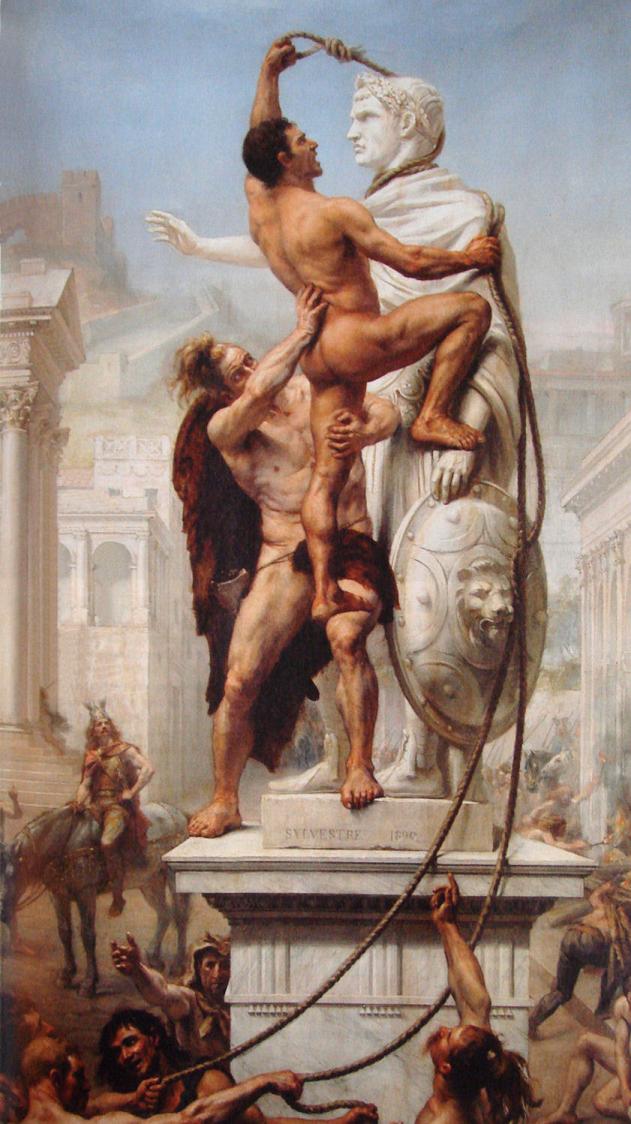
Hate crime against the barbarians
Have been greatly enjoying Waldemar Januszczak' The Dark Ages. In the episode on the barbarians he begins by showing the above "Sack of Rome by the Visigoths on 24 August 410" painted by JN Sylvestre in 1890. It's has all the outrageous drama of a hate-crime against a vernacular culture. Also: the Goths were not naked, they were in fact the ones inventing the trousers!
maandag 1 april 2013
Street sign teaching urban ecology
"Please do not feed the chickens because of the rats". A sign I found in the industrial area & I did indeed see a whole bunch of chickens. Urban chickens are rare but have been covered before. If there is a sign there is probably a permanent rat problem.
zaterdag 30 maart 2013
Richard Brautigan & the Postman
Richard Brautigan: US novelist & poet both obscure and sought after (have been outbid on Ebay several times for a copy of Trout Fishing in America). Today I purchased a recent reprint of three books in one volume and I like what I have read so far. I am also happy to be able to add to my stock of literature dealing with the postal trade (I have done a quiz about it here).
The Postmanand also:
The smell
of vegetables
on a cold day
performs faithfully an act of reality
like a knight in search of the holy grail
or a postman on a rural route looking
for a farm that isn't there.
Carrots, peppers and berries.
Nerval, Baudelaire and Rimbaud.
To England
There are no postage stamps that send letters
back to England three centuries ago,
no postage stamps that make letters
travel back until the grave hasn't been dug yet,
and John Donne stands looking out the window,
it is just beginning to rain this April morning,
and the birds are falling into the trees
like chess pieces into an unplayed game,
and John Donne sees the postman coming up the street,
the postman walks very carefully because his cane
is made of glass.
dinsdag 26 maart 2013
Strolling smacks of introspection
"It is becoming hard these days to justify the pleasures of simply 'going for a walk'. In a world of sponsored hikes and mass marathons, strolling smacks of introspection and an unhealthy lack of competitive drive. Ambling about with no badges of purposefulness (shell-suits and dogs are the favourites) you are looked on as a figure of fun or, worse, of danger. Children cross the road as you approach. Long-distance trekkers elbow you aside, a cissified obstacle not worthy of consideration. Even the physical act of walking is now being streamlined by the health industry. Going for a stroll, one of the most civilized of pleasures precisely because it can be indulged in purely for its own sake, is now expected to do something, either for you or the world."[The picture of course shows writer and long distance walker Will Self, appropriately clad, making a walk work for him.]
- Richard Mabey, A Walk Around the Block (1988)
Birds brooding over inscrutable intentions
A picture of birds in the park last Sunday morning, March 24. Temperature was around zero degrees Celcius and the wind was very strong and from the east. Normally the birds are lively but here you can see them all sitting silently with their head against the wind. A rare sight. Notice the heron sitting by the water. An occasional visitor.
zondag 24 maart 2013
Lichen, eater of trees, crumbler of rock [update]
[my pentax wg-1 (the first camera I have ever owned) has a neat microscope function and these tree-based lichen is what it can do]
Update: lichen do not actually eat trees as pointed out in the comments, I am merely creating drama by referencing to an obscure poem by Lew Welch.
zaterdag 2 maart 2013
Beatscene magazine[s]
Beatscene press is run from Coventry by the Ring's. They publish not one, not two but three long running series of beat generation publications. There is the pocket book series, limited edition booklets with unique material (interviews, memoires) relating to the more recognizable Beat names, for instance Iain Sinclair's reminiscences on his encounters with William Burroughs with a so-far unpublished cut-up by WSB. There is Transit, a little magazine that mainly brings original poetry but my issue is devoted to a long essay on Gary Snyder. But their flagship publication is the Beatscene magzine, a quarterly down to it's 70th issue within a few months. It brings reviews, essays, interviews, scholarly articles, fan writing and original material. In the US especially there is still tons of books being published about anything related to the beats. There is previously unpublishable material like letters and notebooks but there is also a steady stream of biographies, academic works and memories. Some of the original beats are still alive and publishing and Beatscene goes out of their way to speak to them, others are dead and lionized and incorporated into Hollywood and Beatscene will keep up for you. Which is to say that there is still enough happening to keep a magazine filled. The definition for being called a beat is pretty democratic so Beatscene will write with as much zeal for Jack Kerouac as it will for some guy who used to work at City Lights bookstore and published limited edition chapbooks al his life and is probably a complete unknown. The sheer volume of stuff covered is fantastic and, if nothing else, it shows how collectable beat generation material is.
vrijdag 1 maart 2013
Two editions of EhtnoPoetics' grand grimoire
My copy of "Technicians of the Sacred", the big book of ethnopoetics compiled by Jerome Rothenberg, is the revised and expanded edition of 1985. I never liked the book: it's big as you expect, but overweight, the font slightly too large, the pages too white and too white-spaced. Not nice to read and the cover is not very appealing either (down right ugly more like!). Now I have purchased a cheap paperback edition in original edition (Anchor 1969). The cover is much better, the pages of better size but it is almost as big physically despite lacking an entire section. There are 522 pages in the first edition against 636 pages in the second. To my pleasant surprise the revised edition offers major changes which means that I am not just owning two editions of the same book but that I own 2 books that overlap for maybe... only ...80% or even 70%?? It means that a hypothetical aggregate editions of this book would be 1000 pages! And still no material from the Amazon would be included! Comparison shows another problem with this book: the selection for inclusion of material appears even more random than it already did. There is no other book that I like so much and yet find fault with in such large degree. I won't go over it again but the change in material between these two books I find impossible to explain in quality. It could be that the new edition draws in more exotica but only marginally. It's a poetry book and it's a manifesto of a poetic movement and in that light you can possible step over many problems but the apparent random selection of texts points to problem of literary merit: there is so much stuff compiled here from all ages and all places and Technician of the Sacred throws them all together without much digestion or understanding of the original purpose of the material or even the beauty of the language or the originality of the images.
Complaining about ethnopoetics is one of the great joys of ethnopoetics.
dinsdag 5 februari 2013
Notes From a Pioneer on a Speck in Space
Lew Welch is one of many lesser known beat poets who were present at the some of the key events that constitute the 'beat legend'. He wrote beautifully and knew a lot of sadness. Welch disappeared in 1971, he left a suicide note but his body has never been found. Shortly after his already selected collected poetry appeared and in 2012 this was reissued by City Lights with a bunch of B-sides: poems not in the original (for good reason) and a "statement of poetics" Welch's observation on language and poetic language (very original, brilliant). I am not a great reader of poetry (I like bits of Kerouac, Ginsberg I find nearly unpalatable, Snyder only of mild interest, McClure hopelessly pretentious, Waldman a fake) but here I have found a voice to cherish. Google books has a preview. Only a zombie can ignore the silent beauty of this:
Notes From a Pioneer on a Speck in SpaceAnd this poem about a plant also deserves to be quoted in the context of this blog (how can you come up with the idea to write about a plant like this!!):
Few things that grow here poison us.
Most of the animals are small.
Those big enough to kill us do it in a way
Easy to understand, easy to defend against.
The air, here, is just what the blood needs.
We don’t use helmets or special suits.
The Star, here, doesn’t burn you if you
Stay outside as much as you should.
The worst of our winters is bearable.
Water, both salt and sweet, is everywhere.
The things that live in it are easily gathered.
Mostly, you eat them raw with safety and pleasure.
Yesterday my wife and I brought back
Shells, driftwood, stones, and other curiosities
Found on the beach of the immense
Fresh-water Sea we live by.
She was all excited by a slender white stone which:
“Exactly fits the hand!”
I couldn’t share her wonder;
Here, almost everything does.
Skunk Cabbage
1
Slowly in the swamps unfold
great yellow petals of a
savage thing, a
tropic thing-
While no stilt-legged birds watch,
no monkey screams,
those great yellow petals
unfold.
2
Rank plant.
zondag 3 februari 2013
Choose unfamous forests ye hobo
Here follows a supreme 1967 digger-hobo manifesto for permanent transience in/through forests. It's by Lew Welch, one of the lesser known San Francisco beats.
A MOVING TARGET IS HARD TO HIT
Whatever tribe I am the reincarnated member of, apparently won, or lost, or survived, as Ishi’s TRIBE, simply by fading away, dispersing, a whisp of fog no one can strike: “a moving target is hard to hit.” This can be the reverse of cowardice, it takes great courage, at times, to back off from what is rightly your place to stand.
Therefore, this is not advice for all. Some of you are people who stand there and take it, as the poles did, the ones who did, attack the hordes of tanks on horseback, with futile swords. Beautiful, that is your shot. It is not mine.
When 200,000 folks from places like lima ohio and cleveland and lompoc and visalia and amsterdam and london and moscow and lodz suddenly descend, as they will, on the haight-ashbury, the scene will be burnt down. Some will stay and fight. Some will prefer to leave. My brief remarks are for the latter. I will stay. At some distance. Available. But my advice for those who have a way or ways similar to mine: disperse.
Gather into TRIBES of 15 or less. Communal “families” of 5 adults (however divided into sexes) and the natural number of children thereby made, is ideal for nomadic tribal dispersal action.
More than 3/4 of the state of California is national forest, national park, or state forest or park. Take your truck or car and make your camp in the part of the state you like most.
Most parks require that you move in two weeks. Some places require moving every two days. This is only fair. The idea is, no one has the right to hog one campsite for the summer.
Choose unfamous forests. Avoid yosemite. Work, honestly, with the forest ranger. Write the state of california for their booklet. I think the feds have a similar campsite guide.
Also, volunteer for summer fire fighting work. It’s good work, well paid, and necessary. When the fire starts they come to your camp and take you to the scene of disaster.
Another thing, as I was once quoted: “sometimes you only have to step 3 feet to the left and the whole insane machine goes roaring by.” Or something like that.
The point is, for those who have this kind of way, not out of cowardice, but as WAY, that sitting in the haight-ashbury in all that heat and the terrible crowd you cannot help anyway (maybe), is simple insanity.
Disperse. Gather into smaller tribes. Use the beautiful public land your state and national governments have already set up for you, free. If you want to.
Most Indians are nomads. The haight-ashbury is not where it’s at — it’s in your head and hands. Take it anywhere.
…Lew Welch
Church of One
March 29, 1967 San Francisco
Planet Earth
Gestetnered by The Communication Company (UPS) 3/27/67
Labels:
beat,
city in the forest,
diggers,
hippie,
lew welch
zaterdag 2 februari 2013
A visit to the ethnographic museum in Leiden
| Haida Costumes |
"Now, one of the peculiar characteristics of the savage in his domestic hours, is his wonderful patience of industry. An ancient Hawaiian war-club or spear-paddle, in its full multiplicity and elaboration of carving, is as great a trophy of human perseverance as a Latin lexicon. For, with but a bit of broken sea-shell or a shark's tooth, that miraculous intricacy of wooden net-work has been achieved; and it has cost steady years of steady application." - Herman Melville (Moby Dick)
| Chinese print with the carved boards it was made with. |
| Chinese terracotta figures |
| Chinese garment [bureaucracy style] |
| From block to figurine,click to enlarge |
| 200+ year old Japanese bronze |
| Quipu |
| Eskimo Masks |
| Amazonian headdress, much larger than I thought they would be. |
| Another 200+ year old Japanese bronze |
| Hopi painting |
woensdag 16 januari 2013
The Gary Snyder book that inspired a Boulder
Waiting at my climbing gym I leafed through a magazine and came across a mention of a Boulder route in Switzerland called "The Practice of the Wild". This is also the title of one my all time favourite books: Gary Snyder's address of deep problems in simple-speech first published in 1990. Surely (95% certain) the boulder route is named after the book and Chris Sharma the climber who 'opened' the route in 2004 is a fellow Snyderian. The route is a cave climb rated 8c, which is extremely tough and it has only been climbed a few times. The shot above is from Tyler Landman's ascent in 2008.
It's great to see how a book's influence can show up in a completely different practise, even though it's not that far removed from Gary Snyder's own interests. The man has been an avid mountain climber all his life. Kerouac describes their trip up the Matterhorn in Dharma Bums, Snyder climbed Mount Everest when in his fifties or sixties.
There is also a deeper link that is more intuitive. As I was telling about the boulder's name my climbing parter asked me what the book is about and I blanked out completely. I have read it at least four times cover to cover and I read bits from it all the time but what is it about? I am not absolutely sure. It's about a way to live and it shows a way to think about the world and a way to be position yourself in the world in respect to nature from water to cow to human. It describes a moral core. It borrows a lot from anthropology, sixties commune experiments and Buddhism. But that description doesn't feel completely right, it's also something of a mystery book that circambulates a Escherian wordview in which nature is both in a perfect ecological order and unfathomably wild. A boulder route might well be a wordless koan in response to Snyder's challenges.
Climbing parlance talks about "opening" a route. What does that mean in ordinary language: is a climb discovered? created? recognized? divined? revealed? or all of those combined? Perhaps that is what the book is about.
One comment: I think life is more like the endurance of a lead climb than like the explosiveness of a boulder, but I wish it was a top rope problem within my more modest capabilities.
![]() |
| The cover art IS terrible |
vrijdag 4 januari 2013
The political implications of the postal service + experiment
Two examples which we often use to help people to conceive the federal principle which anarchists see as the way in which local groups and associations could combine for complex functions without any central authority are the postal service and the railways . You can post a letter from here to China or Chile confident that it will arrive, as a result of freely arrived at agreements between different national post offices, without there being any central world postal authority at all.With help from the oldest I have just filled 14 envelopes with her drawings and mailed them to Postman Pat in Uzbekistan, Iraq, Papua New-Guinea, Iceland, Japan, Russia, Ecuador, Venezuela, India, Fiji, Kenya, Burkino Faso and Greece. There are also letters to Barbabapa in North and South Korea. All are mailed today, January 4, 2013. Let's see if and how they are returned by the organized chaos of the international mail system!
woensdag 2 januari 2013
EthnoPoetics in the Amazon
One of the strangest oversights in "Technicians of the Sacred" (Jerome Rothenberg's big book of EthnoPoetics, first published in 1968) is the complete absence of material from the Amazon. However, now I have noticed that Rothenberg did pay attention to the region in the third issue of Alcheringa (winter 1971, all issues online here) with a 23-page mini-anthology.
EthnoPoetics was a great, important and inspiring movement but it always suffered from two major problem. 1) It often failed to provide meaningful ethnographic context. 2) Texts from with different historical pedigrees are all translated (often with poetic freedom) into the idiom of avant-garde modernist poetry. Imagine Shakespeare, the King James bible, Coleridge and Tom Jones' Lalya translated into the hurried journalese of an Armenian self-publisher. EthnoPoetics assumes the right to take literature/poetry from every language of the world and reshape it in order to make it confirm to your own agenda. Some people find it colonialist, which I find too easy and too paternalistic. EthnoPoetics offers freedom but does not accepts its responsibilities. The result is often rote blandness where the uniqueness of languages and cultures should be. But let that not deter you from its achievements.
One of the songs in the anthology is a Jivaro shaman song recorded by Michael Harner which makes a nice addition to this earlier Jivaro Shamanic chant (recorded by Philippe Descola).
FIRST SHAMAN SONG
I, I, I, I, I
I, I, I, I
I am ... like First Shaman
I am like First Shaman
When I drink natem
My whole body becomes cold
& I easily suck out that spirit-dart
I, I, I, I
I'm always above the clouds
& that's how corne I have power
Because I drank natem
I drank enough to have power
My whole body is cold
That's how I have power to suck out that spirit-dart
I, I, I, I
There's a very large body of water
So that I'm like a great body of water
I have a crown but it's gold
A crown & it looks so lovely
Lovely when I drink natem
That's why it's easy to suck out that spirit-dart
I, I, I, I
I'm always above the clouds
That's why I can cure so easily
I have the spirit-darts of natem
I'm seated but I do feel cold
There must be lots of breezes around me
I, I, I, I
My spirit-darts are like birds
& the wings & bodies are dreams
I'm. ready to start with them now
My spirit-darts are sitting all over me
& as I get to feel cold
I'll get to have power
I can easily suck out that spirit-dart
I, I. I, I
I'm. like som.e anaconda in the Napo River
That's why I have power to suck out that spirit-dart
I, I, I, I
Wait, wait a little
Now I'm. going to be dizzy
I'll be starting to see when I'm high
Now I've sucked out that spirit-dart(pause, followed by sucking & dry vomiting)
Now the pain will soon go away
Abonneren op:
Posts (Atom)