zondag 26 mei 2013

Plants in & near Amsterdam

 
The backcover to mr. Joh. Bolman's 'Wild plants in and around Amsteram' (1976) informs us that at least half of the 650 native Dutch plant occurring outside nature reserves can be found in Amsterdam. The people of Amsterdam have always been fond of bragging about the biological richness of their city. Mr Bolman writes with the flamboyancy of an Austrian border-guard but he makes up for it with geeked-out precision. Each of the ten chapters deal with a specific family of plants or environmental condition and because of the detailed descriptions he has made it easy for the reader to go out and find specific communities of plants or even individual plants. He mentions for instance a common mallow for years growing behind the fence of the bicycle parking on the West side of the Amsterdam central, I am severely tempted to jump in a train to check if it's still there. The information in this book is very time-specific (summer 1975) but Bolman often refers to the 1852 'Flora Amstelaedamensis' to illustrate changes in the flora and he also relates plants to all sorts of man-made changes in the landscape. This is an old-fashioned book that is brimful with information. It also shows that urban botany also concerns itself with urban history in the most broadest sense.

donderdag 16 mei 2013

Bacteria as material culture

In a paper published in April 2012 Benezra, DStefano and Gordon argue for the foundation of an 'Anthropology of microbes'. Taking a step further from a) the notion that we humans are really a symbiotic supraorganism of humans and microbes and b) that this synthesis bring about "intra- and interpersonal variation of these species and gene assemblages as a function of body habitat, age, physiologic status, and family relationships." The insight that results is the idea that microbial variation is another facet of what informs/creates kinship and culture. Qoute: 
Our microbial communities provide snapshots of those with whom we have lived, the diversity of our daily habits, as well as the impact of our changing lifestyles. For example, our guts are homes to our largest collection of microbes, where the number of microbial cells is measured in terms of tens of trillions. Gut microbial communities in humans are shared among family members and underscore the long-lasting impact of our interpersonal relationships. Common as well as distinct features in gut communities are being documented among populations representing varied “cultural traditions” and geographical locations. The breathtaking rate of change in food availability and preparation methods, the expansive movement of human populations, the rapid proliferation of technology, and the ubiquitous use of antibiotics emphasize the importance of studying the microbiological heritage of humans, just as we study our genetic, linguistic, and cultural heritages.
 The BacterioSphere has no loose ends.
 

maandag 13 mei 2013

Alcheringa times 4


Thirteen issues of Alcheringa, the journal for ethnopoetics, appeared between 1971 and 1980. They are all online. But that is not enough for me: I want to have them! There are copies around but not almost within my budget and/or paypal-sphere. Last year I found one, last week I found three from two different sellers. Two separate issues I purchased on ebay as first/only bid. Like often with reputedly highly collectable material (less obvious William Burroughs for instance): they are not really that sought after at all. While searching for the other issues I can read these and be pleasurably annoyed.

maandag 6 mei 2013

Snooker nicknames [much improved and updated]

Snooker players are now demanded to have nick names by snooker's management. But nicknames are earned not invented. Steve Davis owns 'Interesting' but Mark Selby's 'The Jester from Leicester' alliterates but that is all that can be said in its benefit. Therefore a few suggestions from my side:

Peter Austerity Ebdon
Martin Occupy the University Gould
Barry Fine Young Cannibal Hawkins
Ronnie Day Time Television O'Sullivan
Allister Disturbed Bowel Carter
Ricky Pain in the Lower Back Walden
Mark China Loves Him Allen
Graeme Deputy Accountant Dott
Judd Almost Naughty, Almost Successful Trump
Jimmy The People's Hair-dye White
Dominic Goldilocks Dale
Stephen Maladapted Bacon Neck Maguire 
Mark The Pester of Leicester Selby 
Mark Life Begins at 40 Davis 
John Deep Fried Mars Bar Higgins
Neal Senior Citizen Robertson 
Shaun It's this or MacDonald's Murphy
Stephen Match for Sale Lee

zondag 5 mei 2013

Escaped garden plants in 2013


In addition to the 'weeds in my street' survey I will attempt to collect all escaped garden plants that I find in my daily surroundings. Deciding if a garden plant has gone 'wild' is not a self-evident task. A grape hyacinth growing through the cracks of the paving is obviously not planted but a Narcissus in a neglected flowerbed like above is a different matter. They are planted in parks and road banks throughout the city but a solitary one, hidden beneath a bush, has probably escaped, but how can one be absolutely sure? By noticing plants in unlikely situations elsewhere and by cross-referencing with similar projects (like and like) some additional certainty can be had. The distinction between a garden escape and a recognized wild plant is marked by a thin line. No sane gardener would plant a Giant hogweed or a Japanese hogweed even though both once arrived in Europe as garden novelties. Some plants are both planted by gardeners and weedy: the best example in my street is the Hollyhock that grows in abundance between the tiny space between walls and paving but at the same time you can buy three seedlings for a tenner at the market. 

A prediction: personal ignorance will make it hard to find the exact name for all plants. Your help is appreciated.

The matter of escaped garden plants is a hot topic: after three generations in the wild and when seeding, plants are recognized by the Heukels Flora (the Dutch botanical bible) as native and we are now undergoing an unprecedented influx of new species. The last edition (2005) claims 8% more plants than the 1996 edition and I remember reading or hearing somewhere that the next edition will at least repeat this increase.

All and all this should be an interesting enterprise.


The caper spurge (wolf milk in Dutch) escapes with the garden refuge. Interesting addition. 
Servian bellflowers (I think) growing in a sunny spot around the bend.
Some kind of viola, a plant that I, perhaps unfairly, associate with old ladies.   


The wood forget-me-not is a popular garden plant and well known for escaping. I have spotted a few of them at different places and expect to see more them in the years to come.


A reader suggested annual honesty rather than sweet william catchfly and I think he must be right. It is common this year, I don't remember it from last year.  
The wood viola is occurring at several places, always in tiny patches like this one. Not sure about the name.

Here is an orange hawkweed (thanx Herman) from a municipal flower bed, three meters away.

Escaped from municipal flower bed (see curb)  

Another viola with different colors.
See on Selborne

Again escaped from flower bed
Ghastly plant for right-wing above 65. The detail shows very unclearly shows blue flowers amidst leaves that normally I would recognise as wood sorrel. Any ideas?
I saw tens of this plant in the corner of a building and I think they are potted plants that escaped through a broken bin liner. After months they have finally flowered. Any idea for a name?
Unclear pic, but I assume it is a garden escape.
Another pic drowned in sunlight and photographic incompetence. A popular garden plant this. Next to it
Alkanet, a plant now well established.
No Idea about name.
2 plants, equally ugly, no names.
The flowers look the same as the plant above but it's form is very different.
Common foxglove, one of the witch herbs. It may be wild.


vrijdag 3 mei 2013

Ancient Mesopotamian cities crumbled to dust


Many times I have been asked this question: How do archaeologists find the ancient cities? The should rather be: How can one who is not absolutely blind have any trouble whatsoever in choosing the right spot? Cities are all around.Every mound of dirt is a city. I have yet to find a place in the land of Iraq, except in the newly formed delta, on which one can stand and not see two or three cities outlined on the horizon. - Edward Chiera (They wrote on clay,1938)  

As Chiera explains: the land that is now called Iraq is all washed down from the mountains in the north by the Tigris and the Euphrates. This means that a) the land is flat and b) there are no rocks. Out of necessity clay was the prime material used by the ancient cultures (Sumerian, Babylonian, Assyrian) here living. Fired clay lasts very well as clay tablets show but it takes a lot of resources to bake them so for most practical uses, like building houses, clay was dried in the sun, which makes it usable but not durable. After thousands of years all those houses built on top of crumbled houses created large mounds that in our own time could easily pass for ordinary hills. 


vrijdag 26 april 2013

Hate crime against the barbarians

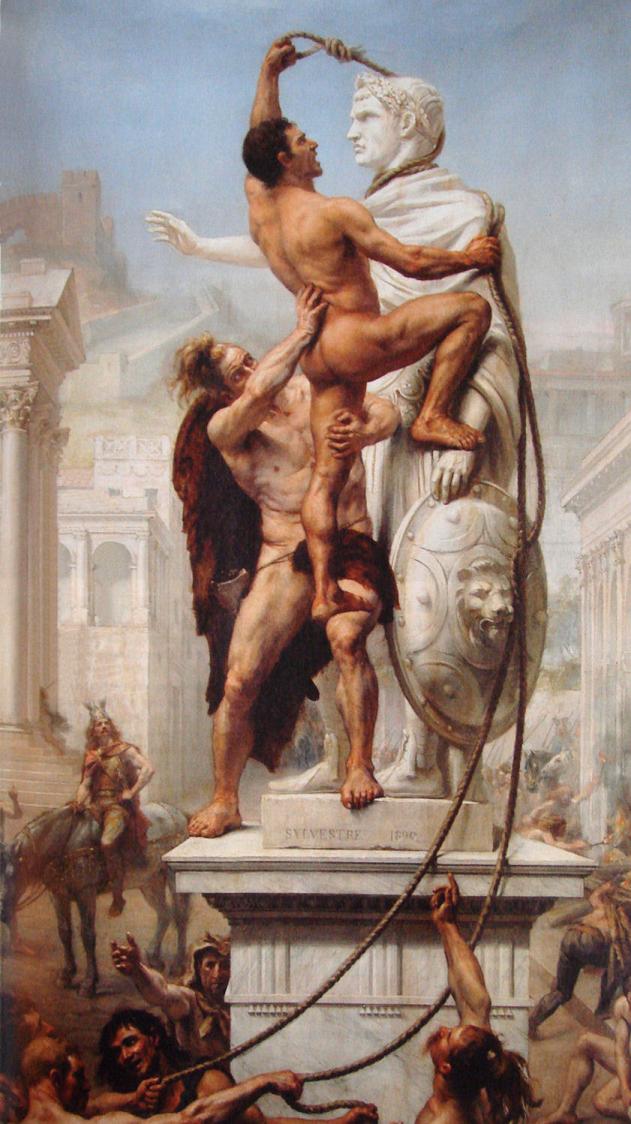
Have been greatly enjoying Waldemar Januszczak' The Dark Ages. In the episode on the barbarians he begins by showing the above "Sack of Rome by the Visigoths on 24 August 410" painted by JN Sylvestre in 1890. It's has all the outrageous drama of a hate-crime against a vernacular culture. Also: the Goths were not naked, they were in fact the ones inventing the trousers!

maandag 1 april 2013

Street sign teaching urban ecology

"Please do not feed the chickens because of the rats". A sign I found in the industrial area & I did indeed see a whole bunch of chickens. Urban chickens are rare but have been covered before. If there is a sign there is probably a permanent rat problem.

zaterdag 30 maart 2013

Richard Brautigan & the Postman


Richard Brautigan: US novelist & poet both obscure and sought after (have been outbid on Ebay several times for a copy of Trout Fishing in America). Today I purchased a recent reprint of three books in one volume and I like what I have read so far. I am also happy to be able to add to my stock of literature dealing with the postal trade (I have done a quiz about it here).    
The Postman
The smell
            of vegetables
                              on a cold day
performs faithfully an act of reality
like a knight in search of the holy grail
or a postman on a rural route looking
for a farm that isn't there.
   Carrots, peppers and berries.
   Nerval, Baudelaire and Rimbaud. 
and also:
To England
There are no postage stamps that send letters
back to England three centuries ago,
no postage stamps that make letters
travel back until the grave hasn't been dug yet,
and John Donne stands looking out the window,
it is just beginning to rain this April morning,
and the birds are falling into the trees
like chess pieces into an unplayed game,
and John Donne sees the postman coming up the street,
the postman walks very carefully because his cane
is made of glass.

dinsdag 26 maart 2013

Strolling smacks of introspection


"It is becoming hard these days to justify the pleasures of simply 'going for a walk'. In a world of sponsored hikes and mass marathons, strolling smacks of introspection and an unhealthy lack of competitive drive. Ambling about with no badges of purposefulness (shell-suits and dogs are the favourites) you are looked on as a figure of fun or, worse, of danger. Children cross the road as you approach. Long-distance trekkers elbow you aside, a cissified obstacle not worthy of consideration. Even the physical act of walking is now being streamlined by the health industry. Going for a stroll, one of the most civilized of pleasures precisely because it can be indulged in purely for its own sake, is now expected to do something, either for you or the world." 
- Richard Mabey, A Walk Around the Block (1988)
[The picture of course shows writer and long distance walker Will Self, appropriately clad, making a walk work for him.]

Birds brooding over inscrutable intentions


A picture of birds in the park last Sunday morning, March 24. Temperature was around zero degrees Celcius and the wind was very strong and from the east. Normally the birds are lively but here you can see them all sitting silently with their head against the wind. A rare sight. Notice the heron sitting by the water. An occasional visitor.  

zondag 24 maart 2013

Lichen, eater of trees, crumbler of rock [update]


[my pentax wg-1 (the first camera I have ever owned) has a neat microscope function and these tree-based lichen is what it can do] 

Update: lichen do not actually eat trees as pointed out in the comments, I am merely creating drama by referencing to an obscure poem by Lew Welch.

zaterdag 2 maart 2013

Beatscene magazine[s]

Beatscene press is run from Coventry by the Ring's. They publish not one, not two but three long running series of beat generation publications. There is the pocket book series, limited edition booklets with unique material (interviews, memoires) relating to the more recognizable Beat names, for instance Iain Sinclair's reminiscences on his encounters with William Burroughs with a so-far unpublished cut-up by WSB. There is Transit, a little magazine that mainly brings original poetry but my issue is devoted to a long essay on Gary Snyder. But their flagship publication is the Beatscene magzine, a quarterly down to it's 70th issue within a few months. It brings reviews, essays, interviews, scholarly articles, fan writing and original material. In the US especially there is still tons of books being published about anything related to the beats. There is previously unpublishable material like letters and notebooks but there is also a steady stream of biographies, academic works and memories. Some of the original beats are still alive and publishing and Beatscene goes out of their way to speak to them, others are dead and lionized and incorporated into Hollywood and Beatscene will keep up for you. Which is to say that there is still enough happening to keep a magazine filled. The definition for being called a beat is pretty democratic so Beatscene will write with as much zeal for Jack Kerouac as it will for some guy who used to work at City Lights bookstore and published limited edition chapbooks al his life and is probably a complete unknown. The sheer volume of stuff covered is fantastic and, if nothing else, it shows how collectable beat generation material is. 

vrijdag 1 maart 2013

Two editions of EhtnoPoetics' grand grimoire


My copy of "Technicians of the Sacred", the big book of ethnopoetics compiled by Jerome Rothenberg, is the revised and  expanded edition of 1985. I never liked the book: it's big as you expect, but overweight, the font slightly too large, the pages too white and too white-spaced. Not nice to read and the cover is not very appealing either (down right ugly more like!). Now I have purchased a cheap paperback edition in original edition (Anchor 1969). The cover is much better, the pages of better size but it is almost as big physically despite lacking an entire section. There are 522 pages in the first edition against 636 pages in the second. To my pleasant surprise the revised edition offers major changes which means that I am not just owning two editions of the same book but that I own 2 books that overlap for maybe... only ...80% or even 70%?? It means that a hypothetical aggregate editions of this book would be 1000 pages! And still no material from the Amazon would be included! Comparison shows another problem with this book: the selection for inclusion of material appears even more random than it already did. There is no other book that I like so much and yet find fault with in such large degree. I won't go over it again but the change in material between these two books I find impossible to explain in quality. It could be that the new edition draws in more exotica but only marginally. It's a poetry book and it's a manifesto of a poetic movement and in that light you can possible step over many problems but the apparent random selection of texts points to problem of literary merit: there is so much stuff compiled here from all ages and all places and Technician of the Sacred throws them all together without much digestion or understanding of the original purpose of the material or even the beauty of the language or the originality of the images. 

Complaining about ethnopoetics is one of the great joys of ethnopoetics.

dinsdag 5 februari 2013

Notes From a Pioneer on a Speck in Space


Lew Welch is one of many lesser known beat poets who were present at the some of the key events that constitute the 'beat legend'. He wrote beautifully and knew a lot of sadness. Welch disappeared in 1971, he left a suicide note but his body has never been found. Shortly after his already selected collected poetry appeared and in 2012 this was reissued by City Lights with a bunch of B-sides: poems not in the original (for good reason) and a "statement of poetics" Welch's observation on language and poetic language (very original, brilliant). I am not a great reader of poetry (I like bits of Kerouac, Ginsberg I find nearly unpalatable, Snyder only of mild interest, McClure hopelessly pretentious, Waldman a fake) but here I have found a voice to cherish. Google books has a preview. Only a zombie can ignore the silent beauty of this:

Notes From a Pioneer on a Speck in Space

Few things that grow here poison us.
Most of the animals are small.
Those big enough to kill us do it in a way
Easy to understand, easy to defend against.
The air, here, is just what the blood needs.
We don’t use helmets or special suits.

The Star, here, doesn’t burn you if you
Stay outside as much as you should.
The worst of our winters is bearable.
Water, both salt and sweet, is everywhere.
The things that live in it are easily gathered.
Mostly, you eat them raw with safety and pleasure.

Yesterday my wife and I brought back
Shells, driftwood, stones, and other curiosities
Found on the beach of the immense
Fresh-water Sea we live by.
She was all excited by a slender white stone which:
“Exactly fits the hand!”

I couldn’t share her wonder;
Here, almost everything does.
And this poem about a plant also deserves to be quoted in the context of this blog (how can you come up with the idea to write about a plant like this!!):
Skunk Cabbage

1
Slowly in the swamps unfold
great yellow petals of a
savage thing, a
tropic thing-

While no stilt-legged birds watch,
no monkey screams,
those great yellow petals
unfold.

2
Rank plant.