- Assume nothing.
- Never go against your gut.
- Everyone is potentially under opposition control.
- Don't look back; you are never completely alone.
- Go with the flow, blend in.
- Vary your pattern and stay within your cover.
- Lull them into a sense of complacency.
- Don't harass the opposition.
- Pick the time and place for action.
- Keep your options open.
Posts tonen met het label psychogeography. Alle posts tonen
Posts tonen met het label psychogeography. Alle posts tonen
vrijdag 18 juli 2014
The Moscow Rules
The Moscow rules is the name for an informal protocol on how spies are to behave while undercover on alien territory. They are fake, it makes their psychogeographic crispness even higher.

zondag 16 februari 2014
Why look at Wild Plants
Flowers are for insects and the flowers you buy from the florist are eugenic monstrosities that in an entomological episode of Snog, Marry or Avoid would get a 100% avoid rate.
Street plants, real plants, have beauty not for their flowers but for the variation of their strategies, the history of their travels and the intricacies of their survival. You do not study urban wild plants to find rarities, though you wouldn't want to miss them, and you never tire of the common plants. The only goal is to learn about what is out there.
Plants are outside and so must you be.
Plants are everywhere and so can you be.
Early on I met a woman with verifiable botanical skills, "she knows her plants". This was at a plant finding expedition near a train station and after taking the first corner we came across a grassy sloped patch with a rosette she, Oh Shock, did not recognize. That is how enormous you can find the world in one little, secluded and everyday place. That is when I learned that the study of wild plants is a process that takes a lifetime. So I take it slow and don't worry about not knowing the name of a plant. It will come to me.
The study of wild plants begins with identification but that is only the way in. Once you know its name you know you can recognize it next time you see it. Once you have seen it twice you can enter into the history (where is it from) and the geography (why is it here) of the plant itself and the place it grows in.
Plants watcher are a nerdy bunch and they have collected data, described places and wrote travel guides for centuries. You know things have gone wrong when you rate a book for the inclusion of plant lists.
My favourite book is the "New Atlas of Dutch Flora" that gives the historic distributions for 1500 individual plants.
But I could not do without many other books, especially the books that take you back to the Utrecht of 1843 or to the Terschelling of 1886 or the Amsterdam of 1975. Often the archaic language alone works miracles.
To speak about plants as a way into something else is all good but the pleasure of seeing a plant is what drives it.
I have not yet used the words 'nature', 'environment' and 'ecology' but they enter the story as well, somewhere.
Plants are just a tiny aspect of urban life but their study gives so much context in so many ways to my surroundings that I now can't imagine ever forsaking it.
dinsdag 10 december 2013
Reading Scarp by Nick Papadimitriou

The six months or so before his book Scarp (2012) was published deep topographer Nick Papadimitriou was the talk of the psychogeographers ghost town (see, see). The radio show he did with John Rogers was a real highlight and together they discussed the upcoming book extensively. I intended to purchase it on the day it would come out but I never did. Only last month I scooped up a remaindered copy on Ebay.
Why did it take so long? Fear of disappointment.
I was afraid that after so much pre-excitement the book could only fail. That it seem to get awfully quiet around Papadimitriou after Scarp's publication only reinforced that feeling.
Now I have read it and I did so with great pleasure. It is much funnier than I thought it would be and his 'proximity flights', when he takes on the persona of other people or animals (the chapter that is eyeing scarp from the perspective of the eternal rook is extremely memorable) work very well. Much of what Papadimitriou makes a fascinating figure has to do with his resolute uniqueness. He is the arsonist that set fire to his school twice, he is also the psychogeographer who rejected the term and created for himself his own system of knowing and internalizing space. The proximity flight is a good example. That he still considers himself to live in long abandoned Middlesex is another.
A different element of my prospected disappointment originates from this stubbornness.
Papadimitriou comes across as someone who has used his walking and studies to sublimate an underlying insecurity and irrationality without 100% success. And this instability comes through in the book and it might have derailed it. But it didn't, instead it adds to the flavour that here is speaking a man who knows how to appreciate things that very few others people can. It is the claim of gurus and saints. The genre this book falls in may be well established but here is a writer who walks out of possession, not one who walks to write. But even then Papadimitriou combines opposites. In his introduction he states with equal weight that Scarp was his object of study long before he identified it as one zone. At the same time the book describes a number of walks made in 2011 with the exact purpose to write about it. Papadimitriou's emotional pendulum seems to swing between a desire for class war and jealously for the security of the middle class, between a need for loliness and a need for love and compassion. Struggles never to be resolved.
Papadimitriou himself connects his deep topology with his underlying psychology. A fair bit of prose is devoted to his account of his troubled youth, his crimes and the resulting brush with the law. Strangely his autobiography never gets beyond him checking into prison and it strongly suggests that the original manuscript was cut in two(or three) and that the rest will only be published when Scarp does well enough.
I rate Scarp very highly, it is not really a book about a place or a person but a shamanic probe into the fundamental matter of desire.
It has the effect on me that I want to go out and walk, it makes me want to buy a plane ticket to go visit Scarp myself. If only Papadimitriou would be my guide.
dinsdag 8 oktober 2013
A derive in the Anthropocene [A transcript] [edited]
Ladies & Gentleman,
I thank you all for joining me on this walk titled: "A derive in the Anthropocene". I hope to explain both the term Derive and the term Anthropocene in a short while but right now I would like to focus your attention to our immediate environment. It's an urban environment, made from wood, metal, glass, bricks and concrete, and long after we are gone the environmental consequences of the mountains that were levelled, the pits that were dug, the forests that were cut, the stuff that was sucked out of the ground and the stuff pumped into the air to built it all will still be there.
The anthropocene is the proposed name given for to our era, the era in which mankind became so dominant that it became possible for a lowely species of primates to influence the history of the earth itself. The rise of the human population is the main factor that creates our planetary influence and the city is the most visible result of that.
We are going on a walk, perhaps you are familiar with the neighbourhood, and I want you to look around it and think of us living our own Vinland Saga. The Vinland Saga is, as you might remember, the story of a small number of Viking sailors colonizing first Greenland, then Baffin island, Labrador and finally New Foundland.
The need for the Athropocene comes from the recognition that the continents and ecosystems that have been brought in contact, the goods that have travelled around the world and the climate, soil and trace element balances that that have been changed, are irreversible actions. And like for Eirik the Red and his people, the overbearing sentiment we bring to Vinland is one of loss. Landscapes, pristine nature (so far it exists) are forever altered, extinction rates are up dramatically. What is happening now will never go away. But it IS a new world, with unexpected sides. Despite mass-extinctions overall biodiversity in many places is rising.
There are differences too of course. Eirik travelled with family and clan from Norway and reached new shore in Greenland. We are not travelling in isolation, we are legion. We have no solitude but crowds. The anthropocene has no places of departure and of arrival. The anthropocene is a mess and in that it is entirely suitable for an age that takes not the clock or the grid but the network as its dominant model.
Another difference is that the Vinland Saga is a tale. The Anthropocene is a grand narrative.
How often will you witness the beginning of a new geological age? This is a time of exploration.
The derive, the drift, known from the past and defined for us by the Situationists in the 1950ties, has lost almost all of its intended radical meaning. In a leisure society where time for sports and play, fun and games is a billion dollar industry the drift is a sanctioned way of approaching places perfectly understandable to consulting agencies and NLP-frauds. But instead of using it to get an insight in the hidden patterns of our surrounding, we might as well use it to reveal the mundane and the sameness of it. It doesn't matter how extreme your psychogeographical techniques (triangulating a route to the Northpole with a .walk in Brainfuck) the anthropocene is everywhere.
Now let's go and I'll tell you more as we proceed.
vrijdag 3 mei 2013
Ancient Mesopotamian cities crumbled to dust

Many times I have been asked this question: How do archaeologists find the ancient cities? The should rather be: How can one who is not absolutely blind have any trouble whatsoever in choosing the right spot? Cities are all around.Every mound of dirt is a city. I have yet to find a place in the land of Iraq, except in the newly formed delta, on which one can stand and not see two or three cities outlined on the horizon. - Edward Chiera (They wrote on clay,1938)
As Chiera explains: the land that is now called Iraq is all washed down from the mountains in the north by the Tigris and the Euphrates. This means that a) the land is flat and b) there are no rocks. Out of necessity clay was the prime material used by the ancient cultures (Sumerian, Babylonian, Assyrian) here living. Fired clay lasts very well as clay tablets show but it takes a lot of resources to bake them so for most practical uses, like building houses, clay was dried in the sun, which makes it usable but not durable. After thousands of years all those houses built on top of crumbled houses created large mounds that in our own time could easily pass for ordinary hills.


woensdag 28 november 2012
Internalising space from a distance

With much zeal but little talent (the instructor implied I was fat, it took me some time before I realized I was wearing my left shoe on the right foot and vice versa) I have taken up wall climbing a few months ago.
These screenshots from Dutch TV program 'klokhuis' shows climbers at the Dutch championships lead climbing 'reading' the route to be climbed, a physical process that involves moving your hands into prospected future states (like reading with your finger) and projecting your body in imaginary positions. Internalising space from a distance. It happens that when I climb a route that looks new on the ground will suddenly come back to me when I am climbing it: my mind forgot it but my body remembers it.
There is a lot of creativity in route building. Sometimes you encounter a route that seems to be built around one interesting move. But the best routes are internally consistent and clearly show the builder trying to achieve a certain effect. With time I am expecting to recognize the hand of the maker in each climb.
Climbing a route is like taking an extremely intensive, condensed and abstracted city walk in an artificial landscape without views but with body-torquing-novelties and spectacular assemblages of jumps, turns, uncomfortable grips, deviations, distractions and sometimes a little redemption.
My favourite part of climbing is when I hit a hard or confusing part of a new route and must then try to figure out where to go next, testing different approaches, moving a hand here or a foot there to decide what is the way forward. In reality this is probably bad practise, the best climbers I have seen move with slow (almost slow-motion) deliberation, clean, efficient and precise. Climbing has to do with creativity, learning and knowing place and all those other cliché's of psychogeography.
When I began it never occurred to me that climbing is a sport (I was thinking of it more as something different to do with your body) and my body is being shocked out of decades of lethargy with lots of pain and suffering. Ouch.
woensdag 25 juli 2012
Dot.Walking the Ghost Town [Occupy the Maze; drifting with Blinky, Pinky, Inky and Clyde]

Rotterdam // August the 3rd 2012// 16.00 Hours
A .walk part of the NAI Summer program.
# “This town, is coming like a ghost town
# Why must the youth fight against themselves?
# Government leaving the youth on the shelf
# This place, is coming like a ghost town
# No job to be found in this country
# Can't go on no more
# The people getting angry”## The Specials
Consider Pacman. Trapped in a ghost town designed to control and subdue him. Running for his life, driven by a hunger that is never filled, eating everything he can only to be forced to do it again and again as he progresses through the system, but in increasingly hostile circumstances. All in the baseless hope that it will get better and that the fear, the existential fear that is his only birthright, will reside. Pacman is in the death grip of a permanent crisis. We all are. It is not a coincidence that generations have mindlessly assumed that Pacman is the good guy, a hero, the employee of the month, but he won't be a role model to my children. Pacman doesn't Occupy the Maze, Pacman is the perfect slave, the one who thinks he is free and happy only because he never tasted true freedom and true happiness. Pacman is not a victim, he is a coward.
# This town, is coming like a ghost town.
Blinky, Pinky, Inky and Clyde are innocent to the concept of labour, their quest to chase Pacman and eat him is purely recreational. Failure is without consequence, the drift is theirs and their wandering strategies are an inspiration to every psychogeographer beyond the maze. Their scatter-chase-repeat routine is a wonder in itself but their swagger in blue mode, when the roles are reversed and they can be eaten by their dinner, is the unchallenged masterpiece in the arsenal of experimental walking techniques. Again the ghosts do not encounter real harm when devoured, they are positively transformed and reborn while travelling. The ghost in blue mode is in trickster mode, they are urging Pacman to feed them power pills not just out of self-interest but out benevolence, to teach him.
# This town, is coming like a ghost town.
Blinky, Pinky, Inky and Clyde are not attacking Pacman, evil is not a useful concept in their carefree existence. They are the Magister Ludi's of crazy cookie land, enticing Pacman to look at the true nature of his condition and rebel against it:
The game is over!
There is no next level!
Pacman goes to heaven, ghosts go everywhere!
Become the ghost!
Conquer da ghost town!
Join the Dot.Walk!
vrijdag 15 juni 2012
My Name is Hou Je Bek and I'm a Psychogeographer [edited]
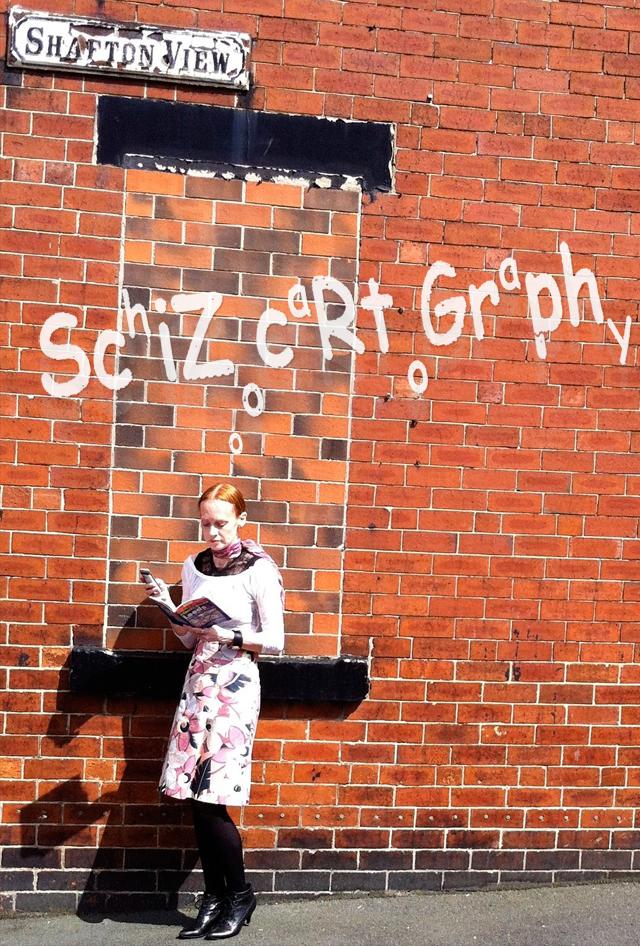
Just in today is Tina Richardson's paper "My Name is Tina and I'm a Psychogeographer: Situating the Addictions and Abuses of Urban Walking Today". From my perspective it is a very funny review of the experienced pitfalls of current psychogeographicness. It tries to come to grips with such eternal questions as: who is 'psychogeography' and who is a mere pedestrian and who is entitled to make such a decision. It covers the 'domination' of Iain Sinclair over the field as if he is the Jamie Beswick of the funny walk, the uncertain status of Will Self as psychogeographer, the tactic (or is it a strategy) to coin terms like Deep Topology or Schizocartography to set oneself apart, and in general how something that is as vaguely defined as psychogeography can be prevented from abuse by snobs and careerist fucks who use the word without ever having pained themselves with the anti-modernist sandpaper redemption of situationist-Marxism.
I recently asked my thesis supervisor what she thought about the increased popularity of psychogeography, as I am somewhat ambivalent about it myself. She thought it was a good thing, but I think she meant this in regards to my future career, because she believes I have caught the wave intime. My own ambivalence is hinged around a practise that I consider to be - by degree - subversive,underground, anarchic and operating against the grain.
In my experience psychogeography is continuously rediscovered, going through its own booms and busts. For many (students of art, urban planning and assorted disciplines) it's a phase, a allegiance they grow out of after a while.
Another thing to be said is that there exists a huge field of of art that works with walking/exploration/mapping and often these people are paying lip-service to psychogeography without labelling themselves as such. Calling yourself a psychogeographer means placing yourself in a very specific tradition and not everybody, for various reasons, feels comfortable doing that. For others this cultish aspect of psychogeography is part of the appeal. In this light I find it remarkable that Will Self, as an established writer and media-celebrity whose books do terribly well, volunteers himself as a disciple (to use a big word) of a tradition that is bigger than all of us.
What did William Burroughs say about art: It's a three letter word. Psychogeography is a fifteen letter word, it's not a profession or a career or an occupation, it's an attitude like vegetarianism or protestantism which is important to people but not by necessity a reason for people (like vegetarians) to get along or agree on even the most basic facts of life.
vrijdag 27 april 2012
Notes on Tati's Play Time
Yesterday I gave my interpretation
of Tati’s 1967 film Play Time. I made a complete fool of myself and I should
have prepared myself better instead of watching the snooker at the Crucible
(that 147!) but here are the notes that I prepared but didn’t use.
Notes on Tati’s Play Time
When I was invited to say something on the
psychogeographical elements in Jacques Tati’s 1967 film Play Time my first
reaction was: Who? Now I have seen the film I can understand why evoking
psychogeography in relation to Tati’s film might be a good idea.
The origin and legacy of psychogeography is
intimately connected to the restructuring of Paris. You could say that it inspired three
generations of dissent; first there was Baudelaire and his portrayal of the
flaneur, then came the Surrealists with their search for the unconsciousness of
Paris, best captured by Louis Aragon in his book on the Paris Peasant and next
came the Situationists who took their analysis of how the rationalization of
Paris was not just a rationalization of the street plan but of society and
daily life itself to a revolutionary conclusion. The work of Haussmann was long
finished when Tati came to make his film and already a new breed of architects
were preparing themselves to redesign Paris
once more and this time do it right. The radiant City of Le
Corbusier is the icon of modernist Paris that never was: 18
gigantic tower blocks for which a considerable part of Paris
south of the Seine would have to be razed. Psychogeography
in that sense was dead simple neighbourhood activism. It is unlikely that Tati ever
read Le Corbusier directly but his proposals were part of the intellectual
atmosphere and Tati (re)created a modernist town that feels right.
Tati: ‘In the first half of Playtime, I
direct the people to follow the architect’s guidelines. Everybody is filmed as
if moving in straight lines and feeling prisoners of their surroundings. Modern
architecture would like typists to sit straight, would like everyone to take
themselves very seriously. In the first part of the film, the architecture
plays a leading role but gradually, warmth, contact and friendship as well as
the individual I defend, take over this international setting and then neon
advertisements make their entrance and the world starts to swirl and it all
ends up in a merry-go-round. There are no more straight angles at the end of
the film’. (quoted from http://www.blueprintmagazine.co.uk/index.php/architecture/jacques-tati-and-architecture/)
When Tati got to design the city that is
the back drop of Play Time he took his ideas of architecture as a monstrous
inhuman art and what you get is a city that is has become one gigantic
undifferentiated hallway in which the hospital, the workplace, the hotel, the
airport are indistinguishable from another. Tati presents the life lived in
such a city where nature has been conquered, design reigns supreme as a bad
dream and where people have been stripped of their wildness, their senses,
forced to ambulate from one place to the next searching for the cheap fix of
inane novelties. In the city of Tati
wandering is either made impossible (the tourist follow a carefully planned
path) or a bureaucratic trick to keep you from reaching your goal, ala Kafka. Halfway
the film Tati’s starts to introduce elements of resistance and the people are
set free. Just as the docile domestic cow sometimes has something of the
primeval wild bovine inside it.
Strangely in his equation of fully planned,
rational environment with the devaluation of humans to drones he almost
verbatim follows Le Corbusier and his dream that a well planned city would
create well behaved human beings. The psychogeographic drift (Ian Sinclair
included) swallows that formula by assuming that drifting, the break-up of a
functional activity into a semi-random play is revolutionarily. The city as a
watch that runs as smoothly as design allows. Tati buys the ideology of
control-through-design but mocks the ideologue. I would argue that this
position both overestimates architecture and underestimates people. Strangely
enough this idea is still with us but in the opposite way. The idea of the
mallable society may have vanished but the precedence of public space over
behaviour resurfaces in the broken window theory that gave the impetus for the
Zero Tolerance policing that you sometimes hear about here too. So: we no
longer believe that design can make us, but an absence of it can break us.
There is a scene in the film where we
suddenly stumble on a great open space filled with a ordered series of free
standing cubicles. In each cubicle sits one person. It is hard to gauge how the
film must have appeared to the viewers in 67 but this is clearly a comic
moment: haha look at what those architect fools have thought off, this will
never pass in real life. No labourers will ever allow themselves to work caged
in a box without any contact with a fellow human. Working like rats in perfect
isolation. Of course the cubicles are here but they are not very popular with
employers because who knows what your employees are doing down there, hidden
away from view…. Probably they are working on their blog.
dinsdag 17 april 2012
Eskimo songlines / Eskimo highways

"The Trail as Home: Inuit and Their Pan-Arctic Network of Routes" by Claudio Aporta is a dense article connecting Canadian Inuit land use and oral knowledge in recent and historic times with personal observation that give some stunning insights into the Eskimo way of life and the human talent for humanizing a harsh terrain. A related article by the same author is here and here.
We were traveling the route that days before Abraham Tagunak had mapped for us. Tagunak, a well-known elder and traveler from Naujaat, had followed that same route for the first time when he was a little boy several decades ago. It was the same trail that members of the Fifth Thule expedition used in the 1920s. It had also been used by Captain Hall’s Inuit guides in the 1860s. In fact, it seems certain that this trail and the place names around it were known to Iligliuk, the Inuit woman who acted as a guide for Captains Parry and Lyon in the 1820s. What is remarkable about this is that trails in the Arctic are not permanent features of the landscape. On the contrary, they disappear when the sled tracks get covered after a blizzard, and as the snow and ice melt at the end of each spring. The spatial itinerary, however, remains in people’s memory and materializes again when the next trailbreaker makes the trip.
to Inuit, the Arctic was in fact a network of trails, connecting communities to their distant neighbours, and to fishing lakes and hunting grounds in between. Based on the data collected during that trip and after mapping over sixty trails in several communities of the territory of Nunavut, I argue here that this network extends across most of the Canadian Arctic, most likely including areas that were not the focus of this research. Since Inuit did not use maps to travel or to represent geographic information, this enormous corpus of data has been shared and transmitted orally and through the experience of travel since time immemorial. Although new trails or new segments of trails are sometimes created to accommodate new travel needs and transportation technologies, while a few others are abandoned, most of these trails are so old that they are part of Inuit’s distant history, perhaps beyond oral memory and certainly beyond the limits of written documentation.
The implications of this premise are several: (1) it rejects the idea of the Arctic as a barren place, or an empty land inhabited by geographically remote and isolated communities (still present in the popular imagination); (2) it implies that Inuit have made systematic use of the Arctic environment as a whole; (3) it suggests that trails are, and have been, significant channels of communication and exchange across the Arctic; (4) it presumes that some types of oral history and knowledge can be accurately transmitted through generations, and (5) it proposes that an important part of Inuit cultural identities is better understood in terms of moving as a way of living.

On place names:
The importance of place names in Inuit culture has been pointed out by several authors. I have elsewhere shown the connection between trails and place names. The mapping of place names makes this connection evident to the point that often the existence of trails can be guessed just by knowing where the named places are. In other words, the spatial layout of the names suggests the existence of a particular itinerary. Figure (above) indicates the presence of a trail across the northern tip of Baffin Island. Through the use of these names, a narrator can describe a trail, identifying creeks, lakes, hills, portages, stone cairns, and landing spots. The oral description of the trail (or the narrative of the journey) will help a listener picture how the horizon will look from the trail, and what kind of features a traveler should expect.

The trail as home:
During his travels in the Eastern Canadian Arctic, Knud Rasmussen documented a ritual just before a newborn child undertook her first journey. After describing the ritual and the prayer, Rasmussen noted that “this was the child’s first journey, and the little girl ... had to be introduced to life by means of [a] magic formula”. Being introduced to the first journey was, in a way, being introduced to life, as if both living and moving were part of the same journey. The trail was a place where life unfolded. Life on the trail involved the learning from an early age of an immense amount of geographic and environmental information, as the individuals experienced the land through actual or figurative travel. Through that process, a sense of community was also developed. The oral and experiential knowledge learned on the trails is, in fact, intertwined with information on and understanding of topographic features, environmental dynamics, and ecology of the familiar region. As Inuit travel to less familiar or more distant regions, this knowledge needs to be acquired from neighboring communities, which suggests a system of tenure in which knowledge equals survival (social and physical). It is through accessing this corpus of knowledge that Inuit travelers from distant communities would be able to find the good trails and the resources necessary to live in other regions.
zondag 1 april 2012
The Ikea of riot control
 |
| Open Street Map does a better job than Google maps. |
The Situationists critique of urbanism was inspired by the redesign of their city. Paris recreated by city planning to make it easier for the police to control it; this in the light of France's long history of revolutions and uprising. San Francisco Digger Emmett Grogan gives an riot-control-through-architecture example for New York: Tompkins Square Park in the Lower East Side of New York. This park has a long history of political dissent and rioting (even OWS was planned here) and its architecture has been adapted to meet any infringes protesters there might want to make on public order.
Tompkins Square Park had been the setting of many riots earlier in the city, and after they took place, several city departments and agencies got together and redesigned the park, stringing it with so much cast-iron fencing that gave the place the look of of a labyrinth and made it virtually impossible for any crowd to move anywhere en masse. The four-foot-high iron railings were placed randomly throughout the park, successfully dividing it up into small sections, and at the same time, separating into easy-to-handle groups any large mob that might gather. Also, in case of trouble, there were handball and basketball courts in the north-east section of the park enclosed and encircled by thirty-foot-high chainlike fences - that could quickly be converted into a makeshift jail or temporarily holding facility for prisoners apprehended during a mass arrest.
I would love to know more about this...
zaterdag 24 maart 2012
Occupy as psychogeographic urbanism [draft 5]

[Draft 5 is much longer and edited in many places, to make it a bit easier: # mostly unchanged, # changed, # new paragraph.]
# The internal organization of Occupy, the refusal to create leaders, the refusal to legitimize outside power and governance (even if only in theory), its indeterminate duration, its state of permanent crisis (read: the risk of eviction) can create a situation where tribal life-ways can be discovered and explored. Occupy starts a process that can turn a well functioning, socially cohesive camp into a self defined tribe (as much Hell Angel as Yanomami) that may feel the need to turn their back on society[11]. At least a few people have recognized from the start that this is the real substance of Occupy. Anthropologist and Occupy Wall Street co-organizer David Graeber has written:
What he is really saying is: we don’t have concrete demands because we are
not interested in changing the world, we are interested in finding a way to
live where we can more fully ignore it. Occupy provides a meeting place and
testing ground for would-be communards. The Scriptonite blog perhaps puts it
best:
“To understand Occupy, you must get one thing. The Occupy Movement is as much about education and information sharing as it is about protest. The purpose of the camps, are to act as villages. They bring people together to share a space, food, ideas and build the personal relationships that galvanise a movement. There is also a massive support structure behind that of social media, direct action and organisational capabilities able to manifest ideas generated on the camps, into realities in the outside world.” [14]
# Once village utilities are in place camps may want to look further for ways to severe more links to the outside world. Learning from experts on foraging, alternative sanitation, alternative energy, alternative medicine, etc, etc, to become fully prepared to move from Wall Street to Wild Street.
# There comes a moment for every Occupy camp that eviction is the best thing that can happen to it. In Utrecht, where the Greens are the biggest political party and likely to agree with Occupy demands, the camp is protected from eviction. But where does that leave you? The camp wilts under the stress of fluffy non-committing tolerance. I was genuinely surprised by the activity and the conversation that was generated at one of their first Saturday-afternoon festivals, but as camp continues people will probably just get used to it and once people get used to they will start to ask awkward questions like: what do you really want. And: does the 99% really exist outside of statistics and is it a statistic that is valid outside the US?
# The occupation of a square or a park may be a photogenic way to show that what’s happening on the news is also happening in the lives of millions of people, but there comes a time to declutter. A few weeks before its eviction the OWS Tumblr page mentioned the rumour that the police were telling homeless to move to Zuccotti park. True or not: the phenomena is recurrent, homeless people find Occupy camps congenial to their own needs but they will often fail to take notice of the rules. Occupy Amsterdam went as far as to negotiate a strategic half-eviction with the police that would evict the drunks, the homeless and the Slavic and leave the prudent and well-behaved true occupiers in their tents. The police as the mercenaries of a middle class tea-cup revolution. Occupy’s Empty Tent Syndrome may not be as bad as the media likes to make it appear but it’s certainly there: taking a bath, recharging your Iphone, phoning you mother, eating a take-away meal (with all that cold you can use the grease), catching an event of your favourite sport, those are things most people prefer to do at home and this is where the homeless and the vagrant win: they can afford to be there all day.
# A movement without leadership is controlled by an elite. There is no reason to invoke a Bourne Provocateur to explain it. A supposedly egalitarian social structure will always create informal leaders and these will have more power if the number of participants increases. I can’t explain the process as a law like a social psychologist can but I am sure it is true. Instead of clinging to willful naivety of 19th century anarchism why not borrow from tribal knowledge and install a chief. Someone from whom you demand feasts and impeccable generosity. Anthropology can offer many cases of social systems where the chief has to work twice as hard to acquire the goods for redistribution he needs to keep his people happy without ever gaining him any power other than the right to speak at the general assembly. I repeat: a leader has the right to speak, and the guarantee that no one will listen. Chiefdom is a way to keep the bossy ones from being boss by isolating them[15]. Start a meeting by calling for a volunteer to be the chairman and then send him or her away to clean the toilets. The Golden Bough starts with an overview of ancient ways to get rid of kings when their time is up; find inspiration there.
# There is a maxim that a culture in decline needs to look outside of itself to freshen up and Occupy is a good example. It has borrowed the idea of a tent camp from Tharir Square, the general assembly model from Quaker public worship (as the Spanish Indignadas claim) and it comes as no surprise that David Graeber, an anthropologist, has become the most visible representative of Occupy Wall Street and by affiliation of the world wide movement. Graeber's thesis advisor was Marshall Sahlins, whose 1966 essay 'The Original Affluent Society' is a foundational text in modern day hunter-gatherer studies (and often reprinted as a primitivist punk zine) pioneering the thought that foraging people are not backwards but free, egalitarian and happy[16]. Add Pierre Clastres' observation that most foraging societies are not relics from the stone age but forms of self-barbarization, a way to be flexible and permanently ready to escape from outside control and you begin to see the true vision of Occupy: the tent is not just a symbol of resistance, it's a promise of tactical lightness that is not defined by protest but by its incorporation of alternative sources of practical skill. Occupy doesn’t need politicians, it needs Eskimo’s, Aboriginals, Bushmen and other people with genuine commitment to their independence. Looked at like this the Occupy movement is not an anarchist movement but an anthropological experiment in creating a situation in which different ways of being a political and social individual can be experienced. There is also a paradox: the only successful communities that could be called successfully anarchic came about by being ignored by the state, not by breaking away from it.
“As we gather together in solidarity to express a feeling of mass injustice, we must not lose sight of what brought us together. We write so that all people who feel wronged by the corporate forces of the world can know that we are your allies.” - Declaration of the Occupation of New York City [1]“It is like a little village. They have got a food tent, a welfare tent, a first aid tent, an information tent, a library tent and a university tent where they have their daily meetings. It is very well organised… They have organised there own portaloos but there is still a problem with street urination… The rainwater gullies have been blocked up with food waste.” – Assistant director of Street Scene on OccupyLSX [2]“At night, with such a big crowd in it, the space had started to redefine itself a bit, and more by ambience than function. People arranged themselves in it more according to how they felt about it. There was an unanswerable question in the air, or so it seemed to me, about what forms of life are possible. In different parts of the Park people gravitated toward different answers.” - McKenzie Wark on Zucotti Park [3]
"The districts of this city could correspond to the whole spectrum of diverse feelings that one encounters by chance in everyday life." - Ivan Chtcheglov[4]
# Psychogeography has moved from revolution
(say: Guy Debord) to nostalgia (say: Iain Sinclair) and I think I know why. The
psychogeographers of the middle 20th century imagined the city as a collage of grandiose
shape-shifting sectors that would be endlessly explored by its inhabitants. The
city would be in permanent revolution, urbanism would by participatory, work
would have be abolished and play would be the core activity of life. Sixty
years later we find psychogeography evoking historic and fantasmagoric cities as
part of the contemporary city through narrative pyrotechnics and the wilful
paranoia of associative anecdote. Its politics is regressive rather than
pro-active, its demands on reality humble. The psychogeographer rather
than create alternative visions from
scratch has gone searching for them in places that have so far escaped
‘development’. The psychogeographer of today walks, in various funny ways,
reports it finds and little else [5]
with the idea that keeping streets alive by using them non-functionally is politics enough. For some psychogeography has become a career. Where did the
enthusiasm for town planning and architecture go? City planning has become
suspect and socially responsible architects are without exception the ones who
destroy the most in their wake. Beware of the demagogue who knows morality and
justice on his or her side. Architects
are upmarket pimps hiding deprivation and slavery behind a smokescreen of
perfumed pompadour and slick braggadocio. Nicholas Hawkmoor had style, Baron
Haussmann at least was earnest and who do we have? A bunch of nameless
'partners' kissing some hand of some godfather in some back room.
Psychogeography has become nostalgic because the present has so little to offer.
The psychogeographer looks out over a tower block, a gigantic mall, a four-lane
motorway and sighs (a psychogeographer is by definition someone without a
driver’s licence). As it happens the psychogeographer is the only one left to
sigh because the rest of the world is too busy talking into their mobile phones.
Needless to say: psychogeographers are suspicious about mobile phones too…
# Sure, an interesting building sometimes
gets built but nobody can still look at a modern building without seeing the
invisible hand behind it: the cabal of investors, bankers, estate-agents, crooked
politicians, construction firms, marketing firms, law-firms, extractive
industries, all dodgy, all corrupt, all purely self-interested. Housing has ceased
to be a basic human right and the simple wish to have a roof over your head
means being forced to commit yourself to a pyramid scheme where the newcomers
will always pay for the exorbitant riches of those who came first. A house is
no longer a home but an investment, a city is no longer a society but a marketing
ploy to be sold to its inhabitants. Of course you can download a
‘psychogeographic’, ‘Situationist-inspired’ augmented reality app that helps
you to forget all this. They cost only 99 cents and will keep you just as
stupid as you already are.
# Every city has its cryptoforests, places
that are camouflaged by nature to hide the discontinued urban. Cryptoforests
are places that are forested and wild but which will inevitable reveal humans
at the heart of it. All forests are psychological actors and the cryptoforest
is no exception, but the cryptoforest is not a 'real' forest, it's also city
and all cities could improve by allowing themselves to cryptofy: to become
cryptoforests, or, like a half-empty glass is also half-full, cryptocities.
Cities that cater to the needs of tent-dwelling semi-nomadic foragers who dance
the night away to celebrate the new grub season. The forager is the
psychogeographic double[6].
# The eviction of the Occupy Wall Street camp from Zuccotti
park on grounds of hygiene is akin to the arrest of Al Capone for tax evasion.
And far away from Manhattan, in my sleepy Utrecht where nothing ever
happens, the same gambit has been tried for the local camp. Conservative politicians
objecting to the camp on the front door of the city council are citing the
major disruption of tourists tripping over tent pegs as reason for eviction. Apart
from offering a way to get rid of a camp on terms that might lead to awkward
accusations of curtailing unarguable rights like the freedom of speech,
political and judicial resistance to Occupy has a deeper reason: they need to
protect the housing-investment pyramid scheme. It is probably safe to say that
not a single one of the 2600+ Occupy groups the world has counted defined
beforehand which of their goals should be met before they will voluntary
abandon camp[7]. They
exist indefinitely until society changes significantly and this is unlikely to
happen soon. As Pete Wright has written: “Change happens through the imperative
for change, not the request,“[8]
and because the economic crisis is the best thing that ever happened to the
established economic superpowers the imperative is not thereat all[9].
In the indeterminate process of occupation people will quickly learn that a
house really is a luxury you can do without, that long exposure to winter cold
(talking about Europeans winters here, not Canadian or Russian ones) makes you
look a bit scary but is perfectly survivable. The criminalization of squatting
and the eviction of Occupy camps are part of the same motive: you are not
allowed to escape.
# The General Assembly model where
"the process toward creative synthesis is really the essence of the
thing" is such a fragile process that it will create a close-knitted community
of trusted others or will fall apart[10].
The consensus model takes away endless talk from a professional class of
politicians to the 'people' and everybody who has ever been involved in
non-hierarchical decision making knows that a person with strong opinions but
little facts and little self-criticism can turn any meeting into a race with
the red queen of dreadful infinity and this alone provides an excellent reasons
for socially cohesive subgroups to break off from the main camp and try their
luck elsewhere.
# The internal organization of Occupy, the refusal to create leaders, the refusal to legitimize outside power and governance (even if only in theory), its indeterminate duration, its state of permanent crisis (read: the risk of eviction) can create a situation where tribal life-ways can be discovered and explored. Occupy starts a process that can turn a well functioning, socially cohesive camp into a self defined tribe (as much Hell Angel as Yanomami) that may feel the need to turn their back on society[11]. At least a few people have recognized from the start that this is the real substance of Occupy. Anthropologist and Occupy Wall Street co-organizer David Graeber has written:
"Zuccotti Park, and all subsequent
encampments, became spaces of experiment with creating the institutions of a
new society - not only democratic General Assemblies but kitchens, libraries,
clinics, media centres and a host of other institutions, all operating on
anarchist principles of mutual aid and self-organisation - a genuine attempt to
create the institutions of a new society in the shell of the old.” [12] [13]
“To understand Occupy, you must get one thing. The Occupy Movement is as much about education and information sharing as it is about protest. The purpose of the camps, are to act as villages. They bring people together to share a space, food, ideas and build the personal relationships that galvanise a movement. There is also a massive support structure behind that of social media, direct action and organisational capabilities able to manifest ideas generated on the camps, into realities in the outside world.” [14]
# Once village utilities are in place camps may want to look further for ways to severe more links to the outside world. Learning from experts on foraging, alternative sanitation, alternative energy, alternative medicine, etc, etc, to become fully prepared to move from Wall Street to Wild Street.
# There comes a moment for every Occupy camp that eviction is the best thing that can happen to it. In Utrecht, where the Greens are the biggest political party and likely to agree with Occupy demands, the camp is protected from eviction. But where does that leave you? The camp wilts under the stress of fluffy non-committing tolerance. I was genuinely surprised by the activity and the conversation that was generated at one of their first Saturday-afternoon festivals, but as camp continues people will probably just get used to it and once people get used to they will start to ask awkward questions like: what do you really want. And: does the 99% really exist outside of statistics and is it a statistic that is valid outside the US?
# The occupation of a square or a park may be a photogenic way to show that what’s happening on the news is also happening in the lives of millions of people, but there comes a time to declutter. A few weeks before its eviction the OWS Tumblr page mentioned the rumour that the police were telling homeless to move to Zuccotti park. True or not: the phenomena is recurrent, homeless people find Occupy camps congenial to their own needs but they will often fail to take notice of the rules. Occupy Amsterdam went as far as to negotiate a strategic half-eviction with the police that would evict the drunks, the homeless and the Slavic and leave the prudent and well-behaved true occupiers in their tents. The police as the mercenaries of a middle class tea-cup revolution. Occupy’s Empty Tent Syndrome may not be as bad as the media likes to make it appear but it’s certainly there: taking a bath, recharging your Iphone, phoning you mother, eating a take-away meal (with all that cold you can use the grease), catching an event of your favourite sport, those are things most people prefer to do at home and this is where the homeless and the vagrant win: they can afford to be there all day.
# A movement without leadership is controlled by an elite. There is no reason to invoke a Bourne Provocateur to explain it. A supposedly egalitarian social structure will always create informal leaders and these will have more power if the number of participants increases. I can’t explain the process as a law like a social psychologist can but I am sure it is true. Instead of clinging to willful naivety of 19th century anarchism why not borrow from tribal knowledge and install a chief. Someone from whom you demand feasts and impeccable generosity. Anthropology can offer many cases of social systems where the chief has to work twice as hard to acquire the goods for redistribution he needs to keep his people happy without ever gaining him any power other than the right to speak at the general assembly. I repeat: a leader has the right to speak, and the guarantee that no one will listen. Chiefdom is a way to keep the bossy ones from being boss by isolating them[15]. Start a meeting by calling for a volunteer to be the chairman and then send him or her away to clean the toilets. The Golden Bough starts with an overview of ancient ways to get rid of kings when their time is up; find inspiration there.
# There is a maxim that a culture in decline needs to look outside of itself to freshen up and Occupy is a good example. It has borrowed the idea of a tent camp from Tharir Square, the general assembly model from Quaker public worship (as the Spanish Indignadas claim) and it comes as no surprise that David Graeber, an anthropologist, has become the most visible representative of Occupy Wall Street and by affiliation of the world wide movement. Graeber's thesis advisor was Marshall Sahlins, whose 1966 essay 'The Original Affluent Society' is a foundational text in modern day hunter-gatherer studies (and often reprinted as a primitivist punk zine) pioneering the thought that foraging people are not backwards but free, egalitarian and happy[16]. Add Pierre Clastres' observation that most foraging societies are not relics from the stone age but forms of self-barbarization, a way to be flexible and permanently ready to escape from outside control and you begin to see the true vision of Occupy: the tent is not just a symbol of resistance, it's a promise of tactical lightness that is not defined by protest but by its incorporation of alternative sources of practical skill. Occupy doesn’t need politicians, it needs Eskimo’s, Aboriginals, Bushmen and other people with genuine commitment to their independence. Looked at like this the Occupy movement is not an anarchist movement but an anthropological experiment in creating a situation in which different ways of being a political and social individual can be experienced. There is also a paradox: the only successful communities that could be called successfully anarchic came about by being ignored by the state, not by breaking away from it.
# Dutch newspapers extensively covered the story of 14 year old runway Kelly
who disappeared from suburbia to Occupy Amsterdam where she fell in love with a
17 year old Czech nicknamed Pikachu, after Pokemon, how sweet. Together they
travelled to Occupy Paris, were involved in a failed attempt to set up camp in
Central Marseilles and planned to travel to Barcelona when her parent intercepted her and
took her back home. A newspaper quoted her mother as saying: “She was driven by
love and a bad time at school[17]”.
It shows that Occupy provides a much needed setting for adventure. It also
shows how Occupy has created a network of places for people to freely move in
to, meet people, discuss the world, share the food, and, hopefully, offer to
help prepare it too. This practical, welcoming, quality of occupy where a
willingness to help pays out in comradely dividend is also addressed by the New
Yorker in an article describing Ray Kachel’s move from unemployment in Seattle
to the adventures of Occupy Wall Street. More than anything else the article
stresses the open sociality of Occupy as one of its strongest assets:
“He
tweeted regularly, and soon had more than thirteen hundred followers. Perhaps
readers were drawn to the modesty and the objectivity of Kachel’s notes on the
occupation. October 8th: “There are elements of communal living. it’s a really
amazing experience tho totally out of my comfort level.” October 22nd: “It
surprises me i have a guardian angel. it doesn’t surprise me he’s a
soft-spoken, hard working Irish guy from the bronx.” October 23rd: “Dear mr.
ferguson. i have lived in new york
for over two weeks now. it does not smell of wee.” October 27th: “Keep seeing
reference to ‘horrendous police abuse’ re: ows. I’ve been here 2+ weeks and
have seen none and heard of little.” November 13th: “I lived in my old
apartment in Seattle
for nearly a decade and barely knew 2 other tenants. . . . i’ve lived in
liberty square for just over a month and regularly talk with many of my
neighbors and have made many new friends.[18]”
# By March 2012 Occupy Utrecht had been
dealing with street violence for a few months but this time one of the
occupiers had retaliated a harasser by beating him on the head with a hammer. A
statement was issued by Occupy condemning the action in the strongest terms
without taking the only proper consequence. They should have pulled backwards
from the boat in order to enter it, as Coleridge would say, and disbanding camp
citing their unwavering commitment to non-violence. They didn’t, displaying a
shocking lack of strategic insight while showing the unwavering stubbornness of
the true believer, and everything that will happen from now on will be a
deception. Incidentally: a while back a university teacher involved with Occupy
Utrecht allowed himself to be interviewed by a newspaper and was quoted as
saying that there are good bankers and bad bankers and that it is important to
see the difference. I wonder how that stellar insight would go down at an OWS
GA. It shows that not all camps are making the same choices when it comes to
tactics, and that not all camps have strategies.
# “The philosophers have only interpreted
the world, in various ways; the point is to change it.” It’s a 1845 Marx quote
used by Occupy groups around the world. Marx had little patience with the well
intentioned but doomed naivety of small groups trying to design a perfect
society in the seclusion of a wilderness. If you want to improve society you
must start by improving political structures. Occupy is unequivocally not
seeking to change the political system from the inside out and this makes it,
in the Marxian analysis, a utopist movement misunderstanding Marx’s slogan.
Still: it is to better to quote Marx wrongly than to quote rightly from that great
unwashed Hegelian harlequin: Slavoj Zizek.
# “The dérive, a technique of
rapid passage through varied ambiences. Dérives involve playful-constructive
behaviour and awareness of psychogeographical effects, and are thus quite
different from the classic notions of journey or stroll.[19]”
Debord wrote this in 1956 and it has been quoted by psychogeographers every
since as its defining statement. What it means is that the drift (usually taken
as the same thing as psychogeography, though it wasn’t for Debord) is a
political act that releases you, even if only temporarily, from all forms of economic productivity and
consumption. Sixty years later we take extensive leisure time for granted and
the drift is evoked as a value free term for personal advancement by artists,
app-developers and all other scum that wants to make it in the so-called
creative industries. The drift is not a walk that is not from A to B, it’s a
way of life that feeds into the psychogeographical restructuring of the city as
a platform of political struggle. Creating a village on the footsteps of the
stock-exchange is psychogeographic, reading Walter Benjamin in a Starbucks is
not.
# Tent city urbanism (and what comes after)
is a far cry from the spectacular models of Constant's New Babylon or the
magico-marxist rereading of the Hawksmoor churches and Canary Wharf.
In that the psychogeography of the recent past has fallen for the spectacle of
the 'legacy'. My first impression of the Occupy camp was that it was paltry, a
dynamo of underwhelming sadness, a place of insignificant littleness, but I
soon realized my initial response was a form of conditioning that must be exorcised
with a pickaxe. I was looking for a hacienda, baroque optical illusions and
empty spaces creating richly filled time and I saw..... battered tents against
a grey building on a clouded day on a miserable Monday morning[20].
And it may well be that at least a few tents are permanently empty, but I like
the idea of Potemkin tent village, a farcical pow-wow of bleeding ugliness at
the heart of the city. Dubai
is a travesty, a weed patch a place of wonder and discovery. The cryproforest
is also battered and paltry, a cheap undefined green that is not a forest, not
a garden, not even a park, but give it half a chance and it will take over
everywhere where humans retreat. The urbanism of the future is the
cryptoforestation of derelict properties, abandoned carparks and never
developed building sites. In this respect the economic crisis is on our side.
Occupy communities are working toward it from the other end, and when the
cryptocity arrives they will find themselves fully prepared for it.
[December 2011 – March 2012]
- Image from
http://www.dailymail.co.uk/news/article-2053463/Occupy-London-90-tents-St-Pauls-protest-camp-left-overnight.html

[1] From October 2011, http://www.dailykos.com/story/2011/10/01/1021956/-First-official-statement-from-Occupy-Wall-Street
[2] The problems of urbanism in a nutshell:
http://www.ehn-online.com/news/article.aspx?id=6010
[3] http://www.thenewsignificance.com/2011/10/07/mckenzie-wark-zuccotti-park-a-psychogeography/
[4] Ivan Chtcheglov's Formula for a New Urbanism.1953; see:
http://www.bopsecrets.or/SI/Chtcheglov.htm
[5] For an overview of contemporary
psychogeography see the Psychogeographic Field Reports [2011]:
http://cryptoforest.blogspot.com/p/psychogeographic-field-reports-zine.html
[6] See: Forage Psychogeography:
http://cryptoforest.blogspot.com/p/what-is-forage-psychogeography-suppress.html
[7] "By October 9, Occupy protests had
taken place or were ongoing in over 95 cities, across 82 countries, and over
600 communities in the United
States. As of November 17 the Meetup page
"Occupy Together" listed Occupy communities in 2,609 towns and cities
worldwide." quoted from http://en.wikipedia.org/wiki/Occupy_movement
[8] http://www.newstatesman.com/society/2012/03/protest-occupy-global-change
[9] Manuel Castells on the economic crisis in a TV interview:
This idea that this is not a crisis, but a trick, do
you agree with that?
Absolutely. On
the trick part. It is a crisis, in economic terms, but the crisis in fact has
been used to improve the power and the profits of the financial groups which
are in fact the leading elite in our society. All major banks and financial
institutions in the last year have reported extraordinary profits. But now the
governments are in a fiscal crisis, the governments need the money, and the
banks say: “Well, in order to be stable and not to go back into our trouble, we
cannot lend it to you. And in fact, the only way we are going to lend something
to someone if you start cutting wages, firing workers, curtailing social rights
and eliminating the collective power of the unions.” In that sense, the trick
part of this statement seems to be empirically supported. Because profits are
hugely up, some of the Spanish banks have reported largest profits in history,
in 2010. And at the same time, the condition has been created for an assault on
the welfare state, social rights, labour union power, and in fact on all the
institutions that were constructing people’s lives in terms of their basic needs.
So I don't think it’s necessarily conspiracy of the capitalist class and
organisation but ultimately it is being used in those terms. So in the
perception of people this is obviously a trick.
[10] David Graeber:
http://occupywallst.org/article/enacting-the-impossible/
[11] For a historic precedent see Gary Snyder, Why Tribe,
1969:
We use the term
Tribe because it suggest the type of new society now emerging within the industrial nations. In America of course the word has
associations with the American Indians which we like . This new subculture is
in fact more similar to that ancient and successful tribe, the European
Gypsies-- a group without nation or territory which maintains its own values,
its language and religion, no matter what country it may be in. The Tribe
proposes a totally different style: based on community houses, villages and
ashrams; tribe-run farms or workshops or companies; large open families;
pilgrimages and wanderings from center to center. A synthesis of Gandhian
"village anarchism" and I.W.W. syndicalism.
[12] David Graeber: Occupy Wall Street's anarchist roots, http://www.aljazeera.com/indepth/opinion/2011/11/2011112872835904508.html
[13] This sounds like a distant echo from
Buenaventura Durruti’s quote from 1936 that was quoted and re-quoted by a
number of Occupy-related blogs
"We have always lived in slums and holes in the
wall. We will know how to accommodate ourselves for a while. For you must not
forget that we can also build. It is we who built these palaces and cities,
here in Spain and America and
everywhere. We, the workers. We can build others to take their place. And
better ones. We are not in the least afraid of ruins. We are going to inherit
the earth; there is not the slightest doubt about that. The bourgeoisie might
blast and ruin its own world before it leaves the stage of history. We carry a
new world here, in our hearts. That world is growing in this minute."
[14] http://www.scriptonitedaily.org/2012/02/voices-from-occupation-sleepless-night.html
[15] For a fascinating similar discussion from
the early 1970ties read Jo Freeman’s ‘The Tyranny of Structurelessness’ and
Cathy Levine’s response, ‘The Tyranny of Tyranny’.
http://libcom.org/library/tyranny-of-tyranny-cathy-levine
[16] Sahlins ‘The Original Affluent Society’ also offers an aesthetic of
forage psychogeography, http://www.primitivism.com/original-affluent.htm:
The construction of substantial houses likewise becomes
absurd if they must soon be abandoned. Hence the hunter's very ascetic
conceptions of material welfare: an interest only in minimal equipment,
"if that; a valuation of smaller things over bigger; a disinterest in
acquiring two or more of most goods; and the like. Ecological pressure assumes
a rare form of concreteness when it has to be shouldered. If the gross product
is trimmed down in comparison with other economies, it is not the hunter's productivity
that is at fault, but his mobility.
[17] http://www.ad.nl/ad/nl/1012/Binnenland/article/detail/3074503/2011/12/13/Ouders-weggelopen-Kelly-gek-van-geluk.dhtml
[18] http://www.newyorker.com/reporting/2011/12/05/111205fa_fact_packer?currentPage=all
[19] http://www.bopsecrets.org/SI/2.derive.htm
[20] Paraphrasing Ivan Chtcheglov's ‘Formula
for a New Urbanism’.
 |
| Occupy WInschoten |
Abonneren op:
Posts (Atom)