Posts tonen met het label history. Alle posts tonen

vrijdag 30 januari 2015

Subordination to and participation in a global system


In the preface to a book collecting some of his lectures "The Global Condition: Conquerors, Catastrophes, and Community" (1992) William H. McNeill makes the following statement about his motivation for being a 'world historian'. McNeill's attempts to write world history within the larger patterns of disease and demographics are fully incorporated by writers better know than him (think Charles Mann) but here he explains it with the clarity of an ideology:
Consciousness of the human species as a whole is potential rather than actual. But just as most of the nations of the earth were created by political events, and then, with the help of historians, achieved a common consciousness, so, it seems to me, real human consciousness can only be expected to arise after political and economic processes have created such a tight-knit human community that every people and polity is forced to recognize its subordination to and participation in a global system. We are not far short of that condition in the last decade of the twentieth century, and world historians, if they are able to construct plausible accounts of how that circumstance arose across the centuries, can perhaps do for humanity as a whole what national historians did for emerging nations in the nineteenth and twentieth centuries, and what more specialized historians have done with conspicuous success for a number of aggrieved subnational groups since World War II." - William H. McNeill

dinsdag 3 juni 2014

The origin and evolution of herbals (Agnes Arber)


It is hard to escape the image of the modern day wild plant watcher as a bearded teacher of the old stamp who would wear a dear stalker on his floral huntings if only his wife would let him. It has not always been like that as Agnes Arber's 'Herbals, their origin and evolution' (1912/1938, reprinted 1986) shows. Arber takes us through the history of herbals between 1470 and 1670, roughly the years spanning the discovery of printing and the emergence of botany as a science in its modern form. There is a great deal to be learned, but what strikes me most is that many of the botanical advances reported share a close proximity to the intellectual spheres as so eloquently described by Frances Yates: the world of Elizabethan Rosicrucians and radical (hermetic) philosophy. Many herbalists were radical protestants, often on the move to avoid prosecution, operating in the intellectual and power hubs of the Renaissance world. We witness the change from medical herbalism to botany, we see how novelties emerge and how stubbornly certain traditions are maintained. We get a glimpse of how the plants of the new world were integrated, and how hard it was to see them for what they were. The earliest herbals in print were often reissues of manuscripts, creating a timeline of at least a millennium for certain texts. 

What makes this book even more wonderful is the liberal use of images. Nothing can beat a good woodcut.


Through sympathetic magic Arber's book also gave me new respect for the Heukels', the most complete lay flora for the Netherlands. Not only does it contain information to the point of singularity it has now also acquired for me the patina of history. If you look of the drawings you can see how little has changed.


zondag 9 maart 2014

The little man of Willemstad


Been bending over this today in the Dutch Royal Museum of Antiquities, its an oak figure with a C14 age of 5300 to 5000 years before present. Its 12.5 cm high and fits in the hand. The image does no justice to seeing the object in front of you. This Fibula was another favourite.

dinsdag 4 maart 2014

The Islami-Mex Mole on the Map


Recently I have been enjoying several pieces by food historian Rachel Laudan. Her recent book I have not yet read but here is an interview. She writes in praise of fast food and about the origin of our diet. The latter is especially interesting for the historic perspective it brings to our modern love for freshness. You can also take her to a supermarket near you. An older piece is The Mexican Kitchen's Islamic Connection that contains the following: 
When Mexico’s leading writer, Nobel Prize laureate Octavio Paz, arrived in New Delhi in 1962 to take up his post as ambassador to India, he quickly ran across a culinary puzzle. Although Mexico and India were on opposite sides of the globe, the brown, spicy, aromatic curries that he was offered in India sparked memories of Mexico’s national dish, mole (pronounced MO-lay). Is mole, he wondered, “an ingenious Mexican version of curry, or is curry a Hindu adaptation of a Mexican sauce?” How could this seeming coincidence of “gastronomic geography” be explained?

...

Paz was right to point out that mole resembled curry, he was wrong to imagine that Mexican cooks had created mole as imitation curry, or that Indian cooks composed curries in an effort to emulate mole. He would have done better to picture both moles and curries as vestiges of the cuisine of medieval Islam, a cuisine that was enjoyed from southern Spain in the west to northern India in the east.

...

In the early 16th century, as the Spaniards were introducing their version of Muslim cuisine to Mexico, the Mughals conquered northern India half a world away. They came by way of Persia, which had become the cultural and culinary center of the region since the Mongols had ruined Baghdad more than 200 years earlier. It was this Persian version of Muslim cuisine that their cooks adapted to Indian circumstances, creating the sophisticated Mughal cuisine of New Delhi. By the mid-16th century, then, a belt of high cuisine could be traced from northern India westward to Mexico. Although in every area it had been adapted to include local ingredients, the basic techniques and the basic dishes of medieval Islam continued to form the basis of all the local variants.
The article provides a brief glimpse into the way food-cultures wander, how tradition incorporates new ingredients without losing integrity, but also how incoming styles of food become naturalized and localized. Food history as study of the way old dishes are created from new and new dishes from old. By placing such processes in the context of state-making and empire building Laudan can write about cuisine-formation (what a word) within an evolutionary framework. 

Within evolutionary biology sits is the study of biogeography, the study of the geographical distribution of life, its most famous case study is the recolonization of Krakatau after its explosion. So if such a thing as gastrogeography can exist within the History of Food what would be its Krakatau? The introduction of the potato in the diet of the old world? The patenting of Coca-Cola? The release of Islamic cuisine in the new world? Or perhaps we should look at islands like biogeography has done since the time of Wallace and Darwin. Lauden provided for that too with her earlier book The Food of Paradise, Exploring Hawaii's Culinary Heritage which tells the story of Hawaiian gastrogenesis (yeah!) from three different cuisines meeting on the culinary clean slate of Hawaii.

If you would want to take this one step further you could look to formalize and describe events of cuisination (read cuisine speciation, the process of cuisine formation), cuisine radiation (the splitting of a cuisine into several cuisines), cuisine revolution (the sudden and drastic change of a cuisine), cuisine decay (the process of a cuisine losing its coherence), cuisine collapse (the complete annihilation of a cuisine).

Map your Recipe is my way to address these things and what else could I do but get a recipe for Mole and feed it to the program. The resulting map is above. In terms of food regions it brings together the two Indian and Mediterranean centers, the lateral extremities of the the Islamic empire, but there is also a very strong presence of new world ingredients as the graph below shows. It is extremely rare to find a recipe that exceeds the 50% use of new world ingredients and for this achievement alone I find Mole impressive.

I was how wondering how Map your Recipe would guestimate the Mole, would it recognize it as Mexican or maybe (also) as Indian or Indonesian or Moroccan. After a little adjustment it now recognizes Mole as Mexican.

zondag 15 december 2013

The NOMA ready-mades

Etnobotanica brings together papers on European wild plant use in places that I would consider obscure (ohh that Dutch self-centredness). There is much on Albania and Macedonia for instance. It's a fantastic resource and I have pointed to another paper earlier

"Wild food plant use in 21st century Europe: the disappearance of old traditions and the search for new cuisines involving wild edibles" by Łukasz Łuczaj and others gives a broad overview on the current status of foraging. It notes that one hand the traditional knowledge of wild food is disappearing while at the same time it is reinvented (not reintroduced as the paper argues) in avant-garde cooking. 

In all it is a bit scattershot, but that is only to be expected for such a huge and complex field in which every country has its own history and where generally there little overlap between separate traditions exists. Good piece to get you talking. I am happy in the meanwhile with the different plant lists like this this stocking-list from a South Swedish wild food firm that also supplies Noma. It is a list that contains so many plants that are growing between the cracks of the pavements or in neglected gardens that it once again shows how much of Michelin-starred wild food cooking resembles the experiments of Surrealism to create extraordinary sensations by rearranging ordinary and/or discarded material like bus cards and cut-outs from newspapers. 


maandag 9 december 2013

Charting the geographical and numerical spread of ingredients from 29 historic cookbooks

 
From various places (Gutenberg, Archive, Bit-Torrent) I have collected the full text of 29 cookbooks published between 1390 and 2010.

I will not bother you here with the full list, but the earliest is the Forme of Cury (1390) and the latest is the Paleo Diet cookbook (2010). In between there are classics like The Book of Household Management by Mrs. Beeton (1859), A guide to modern cookery by Auguste Escoffier (1907) and the Naked Chef by Jamie Oliver (1999). I have tried to find books evenly spaced through the years and have cleared them as best as I could from non-intentional ingredients. Book by book I fed all of them into Map you Recipe and collected the raw numbers that are used to make the graph above.

It maps the number of ingredients (vertical axis) for 29 books identified by year of publication (horizontal axis). The green top line tracks total number of ingredients recognized, two lines track how many of those are from the old or the new world and one line indicated from how many of the 15 food categories Map your Recipe uses ingredients are drawn from. 

Here are some observations that I think are fascinating. 

- Over time cookbooks have an increasing list of potential ingredients.  

- The big change comes about 1600 when the number of ingredients sharply rises. 

- It takes to about 1650 when produce from the Americas start to be seriously introduced to the larder.
- The food stuffs from the Americas on there own or not enough to explain the sudden increase in 17th century.

- From 1700 onwards the total use of ingredients goes up (130 max) and down (61 min) but it never goes down enough to come near the level of 1658 (41 ingredients) which at that time is the record.  

- The first cookbook with more than a hundred ingredients dates from 1851, but this remains an exceptional number for a long time.

- The Paleo-diet cookbook has the highest total number of ingredients. It is ironic that a so-called 'caveman diet' seems intent on using as much agricultural crops at it can.

- Nigella Lawson in 2007 uses 29 more ingredients than J. Oliver in 1999.
There are a few caveats. In an earlier post I did the same for 15 books searching only for those fruits and vegs that Vavilov was able to trace to a specific food hearth. In the mean time I have also added many other food stuffs that are known to originate from the old or the new world but without the specificness of the Vavilov list. The problem with the additional list is that it is in potential infinite. This is even true when you exclude meat and fish as Map you Recipe does. So you don't know what is missing even though I expect it to pick up 99% of the most common ingredients. 

This graph is not intended to be the final word nor does it make claims for extreme precision. It is meant as an illustration for general trends in food over time and I think it is very revealing. 

maandag 25 november 2013

The Natural History of London


R.S.R Fitter's 'London's Natural History' (1945) is what we would now call an environmental history of Greater London. It is strangely antiquated, refreshingly modern, stunningly original, and, at times, bloggerishly quirky. All at the same time.

When Fitter cites Piltdown man it is a thing of the past but when he writes about houses as a new form of habitat that by necessity have to be pioneered by plants and animals seeking living space and using adaptation to make it theirs, he opens my eyes to the evolutionary cunningness of the ants, slugs and silverfish crawling in my living room. 

There is plenty of raw material (plant and bird lists) for Fitter to use and as a writer of guidebooks he loves that stuff. There are also many good maps and that is one reason why this book lives: it is a source of raw data that is still of interest to birdwatchers and phyto-psychogeographers. This book was written during WWII and the most original chapters are those in which Fitter documents the results of the Blitz as a great opportunity for nature to return to the surface in some of the oldest continuesly built-over parts of the City. It strikes me as both eccentric and typical of the stoic attitude that famously is said to have come over the citizens of London in response to German attacks. Bombs or not live must go on and that included scouting bombcraters for unusual flowers. 

Nice book.

donderdag 14 november 2013

The weeds in my Colosseum


In 1855 Richard Deakin published a study of the wild flowers growing in and on the Colosseum in Rome. It is available online. There was an earlier study and there has also been done a recent study and what it allows for is a study of place through the study of plants. Deakin's book contains a list of plants with descriptions. In the preface he writes: 

The object of the present little volume is to call the attention of the lover of the works of creation to those flocal productions which flourish, in triumph, upon the ruins of a single building. Flowers are perhaps the most graceful and most lovely objects of the creation but are not at any time, more delightful than when associated with what recalls to the memory time and place, and especially that of generations long passed away. They form a link in the memory, and teach us hopeful and soothing lessons, amid the sadness of by- gone ages : and cold indeed must be the heart that does not respond to their silent appeal ; for, though without speech, they tell of that regenerating power which reanimates the dust of mouldering greatness, and clothes their sad and fallen grandeur with graceful forms and curiously constructed leaves and flowers, resplendent with their gay and various colours, and perfume the air with their exquisite odours. The plants which we have found growing upon the Colosseum, and have here described, amount to no less a number than 420 species ; in this number there are examples of 258 Genera, and illustrations of 66 of the Natural Orders of plants, a number which seems almost incredible. There are 56 species of Grasses, 47 of the order Compositea or Syngenesious plants — and 41 of the Leguminous or Pea tribe.
The collection of the plants and the species noted has been made some years ; but, since that time, many of the plants have been destroyed, from the alterations and restorations that have been made in the ruins ; a circumstance that cannot but be lamented. To pre- serve a further falling of any portion is most desirable ; but to carry the restorations, and the brushing and cleaning, to the extent to which it has been subjected, instead of leaving it in its wild and solemn grandeur, is to destroy the impression and solitary lesson which so magnificent a ruin is calculated to make upon the mind.

dinsdag 12 november 2013

Carl Sauer's maps on agricultural origins


Carl Sauer, cultural geographer, author of the brilliant New Spanish Main on the Spanish landnam of America after Columbus, also wrote one the origin and spread of food crops and domesticated animals. Vavilov suggested a number of centres of origin, the so-called hearths. Sauer preferred to talk about Centres of Dispersal. Sauer came later but Vavilov is still the better known name. I have no clue what the current scientific validity is of both theories but it is certain helps that Sauer's Agricultural Origins And Dispersals (1952) is available on Archive.

Great maps, click to enlarge.    

zaterdag 28 september 2013

Map your Recipe [new website][updated]


Map your Recipe does a simple thing: enter the ingredients of a recipe and it will show you where the vegetables that went into it were first domesticated.

Map your Recipe shows that we are firmly after the Columbian Exchange and that no national cuisine relies only on truly local ingredients. But with interesting local patterns of usage and borrowing.

Map your Recipe will ignore those ingredients that can not be pinpointed to a specific centre of origin. 

Mail questions and/or suggestions to wilfriedhoujebek who has a yahoo account.

maandag 26 augustus 2013

The discovery of America in 3 strange maps.

Included in the Penguin edition of the Vinland Sagas (two medieval Viking tales about the discovery and settlement of Greenland and further exploration into the Americas) is a map based on the sagas first created in 1590 by Icelandic teacher Sigurdur Stefansson. There is England, Ireland and islands on the right and Helleland (Baffin Island), Markland (New Foundland) and Skraeling land (Red Indian land, Labrador?) on the left. Greenland is shown as continues with it (pack ice?). It is clearly recognizable from the point of view of present cartographic knowledge.

Now take a look at these two books from the Zorzi codex reproduced in Carl Sauer's excellent book about the first years of Spanish expansion, "The New Spanish Main". They were made in 1525 at the latest and show the way Columbus' brother Bartholomew (and by extension Columbus himself) imagined their discoveries as part of the new cartography. Never able to come to terms with their landing on a new continent, they needed to account for it as outlying islands at the extreme perimeter of East Asia. A passage to the heart of it was only a matter of time. Sauer notes that observers at the Spanish court understood the fallacy at an early point and even at the time these maps were anachronistic.


vrijdag 3 mei 2013

Ancient Mesopotamian cities crumbled to dust


Many times I have been asked this question: How do archaeologists find the ancient cities? The should rather be: How can one who is not absolutely blind have any trouble whatsoever in choosing the right spot? Cities are all around.Every mound of dirt is a city. I have yet to find a place in the land of Iraq, except in the newly formed delta, on which one can stand and not see two or three cities outlined on the horizon. - Edward Chiera (They wrote on clay,1938)  

As Chiera explains: the land that is now called Iraq is all washed down from the mountains in the north by the Tigris and the Euphrates. This means that a) the land is flat and b) there are no rocks. Out of necessity clay was the prime material used by the ancient cultures (Sumerian, Babylonian, Assyrian) here living. Fired clay lasts very well as clay tablets show but it takes a lot of resources to bake them so for most practical uses, like building houses, clay was dried in the sun, which makes it usable but not durable. After thousands of years all those houses built on top of crumbled houses created large mounds that in our own time could easily pass for ordinary hills. 


vrijdag 26 april 2013

Hate crime against the barbarians

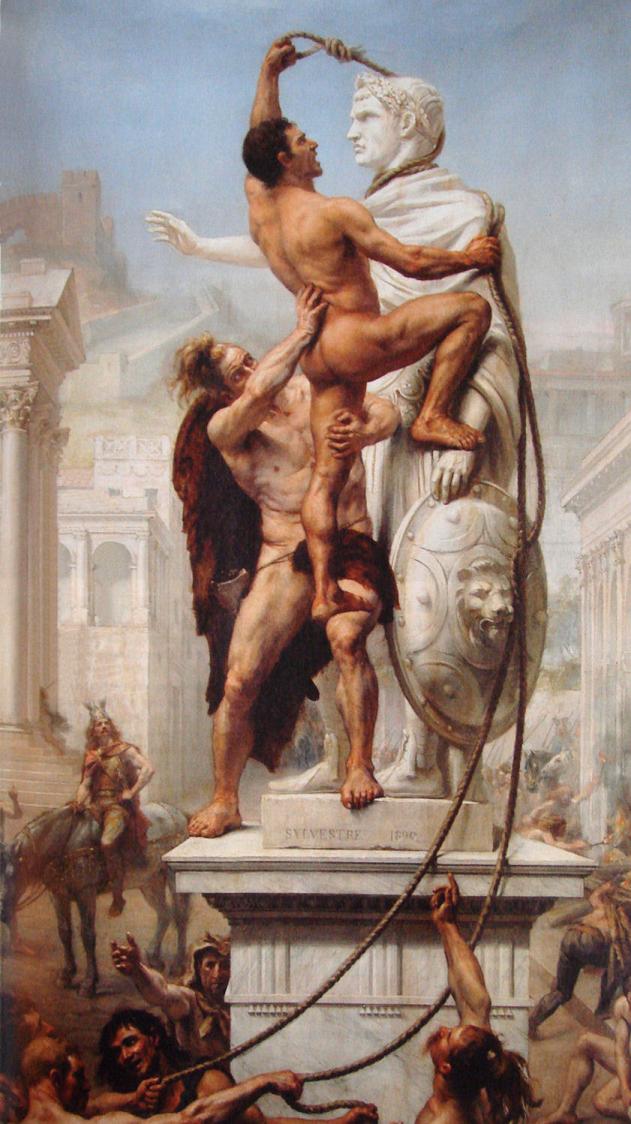
Have been greatly enjoying Waldemar Januszczak' The Dark Ages. In the episode on the barbarians he begins by showing the above "Sack of Rome by the Visigoths on 24 August 410" painted by JN Sylvestre in 1890. It's has all the outrageous drama of a hate-crime against a vernacular culture. Also: the Goths were not naked, they were in fact the ones inventing the trousers!

dinsdag 7 augustus 2012

Everything you need to know about the Diggers


On Sunday 1 April 1469 a group of poor men (described as labourers in a legal action three months later) collected on St George's Hill and began to dig the waste land there [To dig up Georges Hill and the waste Ground thereabouts, and to Sow Corn, and to eat our bread together by the sweat of our brows]. It was a symbolic assumption of ownership of the common lands. It was a further symbolic rejection of conventional pieties that the digging began on a Sunday. [In the beginning of Time, the great Creator Reason, made the Earth to be a Common Treasury, to preserve Beasts,Birds,Fishes, and Man, the lord that was to govern this Creation; for Man had Domination given to him, over the Beasts, Birds, and Fishes; but not one word was spoken in the beginning, That one branch of mankind should rule over another.] The numbers of the Diggers soon rose to twenty or thirty. 'They invite us all to come in and help them,' an observer noted, 'and promise them meat, drink and clothes. they give out, they will be four or five thousand within ten days. It is feared they have some design in hand'. It was a brief episode in English history, involving perhaps a few score men and their families: we know the names of seventy-three of them. Historians are becoming aware that it was not quite so isolated in occurrence as used to be thought. We should see the Digger colony on St. George's Hill as merely one particularly well-documented example of a trend which was repeated in many other places. [Not only this Common, or Heath should be taken in and Manured by the People, but all the Commons and waste Ground in England and in the whole World, shall be taken in by the People in righteousness, not owning any Propriety; but taking the Earth to be a Common Treasury, as it was first made for all.] Other Digger colonies appeared at Wellingborough in Northhamptonshire, Cox Hall in Kent, Iver in Buckinghamshire, Barnet in Hertfordshire, Enfield in Middlesex, Dunstable in Bedfordshire, Bosworth in Leicestershire, and at unknown places in Glouscestershire and Nottinghamshire. Winstanley and twenty-one other Diggers went backwards and forwards visiting colonies and groups of sympathizers. 

The relevant segments from Cristopher Hill's 'The world turned upside down' (1972) combined with quotes from the True Levellers Standard Advance (1649) in brackets bring together everything you need to know about the Diggers.

Related: 

donderdag 19 juli 2012

The Comanche Empire

Nomads, the historical records show, can evade, resist, stop, sustain, exploit, destabilize, and destroy empires. They can also build enduring empires of their own, but only if they modify the essence of their being and became less nomadic. Nomadism appears fundamentally incompatible with empire-building. Empires thrive on structure and stability, whereas nomads - at least the nomads one finds in most scholarly studies - are shifting and factional. Their institutions, like their very way of life, tend to be fluid and ephemeral, and they lack such classic elements of empires as state structure and surplus-generating agriculture. Indeed, to preserve their might, nearly all nomadic empires develop over time more fixed institutions of governance and production that required at least seasonal sedentarism. 

Countless colonial officials failed to comprehend and contain the Comanches. Comanches deflected the controlling gaze of colonial agents through their traditional political culture in which power was dichotomized, leaders could be both strong and weak, and group membership was flexible. A vast collection of relatively autonomous bands and organized for multipolarity and fluidity, the Comanche nation appeared formidable and fragmented, structured and shapeless, incomprehensible and impregnable all at once. Seen from the outside, the Comanche nation was an amorphous entity that lacked a clear center to negotiate with - or obliterate - and an explicit internal structure that would have rendered its external actions predictable. The Comanches, it seems, were so dominant not in spite of their informal, almost atomistic social organization but because of it.
The Comanche Empire (Yale, 2008) by Pekka Hämäläinen has been my best read in months. It describes the emergence of an obscure band of Shoshone's on the great plains just before 1700. Here, equipped with horses and fired by unbounded energy these former hunter-gatherers created the wide-ranging semi-nomadic, trade-centred, raiding-dependant Comancheria empire that lasted for over a century. George Catlin, who painted the Comanche village above in 1834-35, estimated that principle Comanche village had six to eight hundred tipis organized in long parallel lines "which gave the settlement  a gridlike appearance of streets and rowhouses," according to Hämäläinen. On the outside this book is the story of the rise and fall of the Comanches, but it also incorporates anthropological and ecological views, explaining how ecological factors and social organization contributed to their success. The Comanches, I can't help myself comparing, were the Vikings of the great plains.

woensdag 30 mei 2012

A little bit of Gerrard by my side, a little bit of Winstanley is all I need, a little bit of revolution in the sun, a bit of proto-communism all night long

The special quality of the writing of Gerrard Winstanley (1609-76), the radical English protestant priest often seen as a proto-communist-communard, is that it's easily incorporated by radicals who came after him. To give a recent example, the San Francisco Diggers named themselves after Winstanley's followers and provided free food after their example. In the light of Transition, Dark Mountain, Occupy and bioregionalism Winstanley is again quotable as a forerunner of all back-to-the-land gardeners and farmers. Question: does foraging 'make the earth fruitful?' 
...one sort of children shall not be trained up only to book learning and no other employment, called scholars, as they are in the government of monarchy; for then through idleness and exercised wit therein they spend their time to find out policies to advance themselves to be lords and masters above their labouring brethren, as Simeon and Levi do, which occasions all the trouble in the world. 
The first fountain is the right planting of the earth to make it fruitful, and this is called husbandry. And there are two branches of it: As first, planting, digging, dunging, liming, burning, grubbing and right ordering of land, to make it fit to receive seed, that it may bring forth a plentiful crop. And under this head all millers, maltsters, bakers, harness-makers for ploughs and carts, rope-makers, spinners and weavers of linen and such like, are all but good husbandry.

The second branch of husbandry is gardening, how to plant, graft and set all sort of fruit trees, and how to order the ground for flowers, herbs and roots for pleasure, food or medicinal. And here all physicians, chirurgeons, distillers of all sorts of waters, gatherers of drugs, makers of wines and oil, and preservers of fruits and such like, may learn by observation what is good for all bodies, both man and beasts.

....an idle, lazy contemplation the scholars would call knowledge; but it is no knowledge but a show of knowledge, like a parrot who speaks words but he knows not what he saith. This same show of knowledge rests in reading or contemplating or hearing others speak, and speaks so too, but will not set his hand to work. And from this traditional knowledge and learning rise up both clergy and lawyer, who by their cunning insinuations live merely upon the labour of other men, and teach laws which they themselves will not do, and lays burdens upon others which they themselves will not touch with the least of their fingers. And from hence arises all oppressions, wars and troubles in the world; the one is the son of contention, the other the son of darkness, but both the supporters of bondage, which the creation groans under.

vrijdag 10 februari 2012

Two books with three-word titles, both containing the words 'food' and 'history'


Recently I have read two books on the History of Food.

The first was 'Food in History' by Reay Tannahill. It was first published in 1973 but my Penguin is a revised edition of 1988. It's an easy read that deals with the origin of our food-sources, the history of national cuisines and the complexities and political issues civilizations from the Romans to the present have needed to overcome to feed itself. The first part deals with pre-agricultural food and seems very low on information content and maybe a bit outdated, the last part deals with food security in the language of the 1970ties. It's a good book to get a general picture of things (the history of Chinese cuisine in 3 pages, a few medieval recipes, the birth of modern cookbooks, the assimilation of corn in the European diet, etc etc) but it doesn't really nourish in the long run. 

The second book I read was 'History of Food' by Maguelonne Toussaint-Samat. It was first published in French in 1974 and translated to English in 1992. It's a 700 page tome of small print that comes with endorsements by Raymond Blanc and H.G. Ballard. It solely deals with the history and cultural facets of individual food sources, it neglects non-European cuisines and is Franco-centric to a fault. I haven't actually read it because its is unreadable. This book is like a collection of Wikipedia pages on speed or like one of those Chinese encyclopaedias Borges wrote about. The matter is made worse by the fact that chapter-headings only provide a meagre indication of what the chapter will actually be about. This history of food is unsystematic to the point of randomness, but not in a good way. What I find especially annoying is that Toussaint-Samat makes grand claims about all sorts of things (the origin of language included) without any reference or source. This book is a waste of space.

The dictum is: never read one book. In this case it is followed with: two is not enough either and readers of this blog are encouraged to submit better books on the subject if they know any. Thank you!